Learning English Through Reading: The Natural Way to Build Fluency
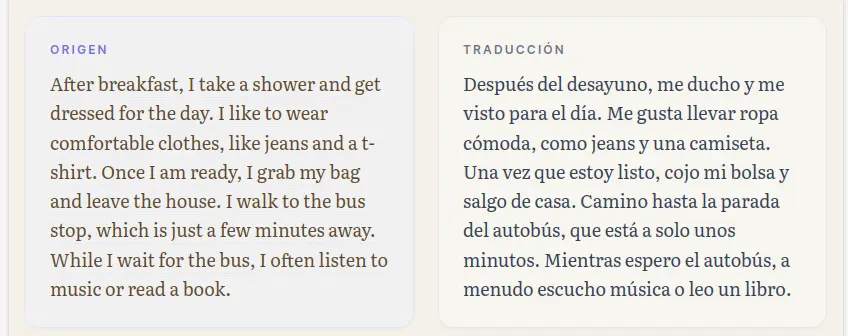
You can study English for months and still freeze when you see a normal sentence.
You know the grammar rule. You remember the word from a flashcard. But when everything appears together in a real paragraph, your brain slows down.
That is the problem reading solves.
Reading gives you English in context. Not as isolated words. Not as grammar tables. As meaning, rhythm, phrases, and situations your brain can understand.
Try the method first: Generate your first bilingual story and read English with translation beside it.
Why Reading Feels Slower at First
When you read in English, you meet many things at once.
Vocabulary. Word order. Verb forms. Prepositions. Articles. Phrasal verbs. Small words that look simple but change the whole sentence.
At first, this feels heavy.
A sentence like “She looked up the address before leaving” is not hard because of one big word. It is hard because of the whole structure.
“Looked up” does not mean “looked” plus “up.” “Before leaving” uses a shorter form instead of “before she left.” Your brain has to process the phrase, not just translate each word.
This is exactly why reading works.
It trains you to see English as connected meaning, not as separate puzzle pieces.
Why Memorizing Words Is Not Enough
Memorization feels faster. It gives you a clear result.
You learn twenty words. You feel productive. You can test yourself.
But then you meet those same words inside a real story, and they behave differently.
Take the word “get.”
You can get a message. Get tired. Get home. Get someone to help. Get over a problem. Get along with a colleague.
A flashcard cannot teach all of that naturally.
Reading can.
When you see the same word in many situations, your brain starts to build a flexible meaning. You stop asking, “What is the translation?” and start feeling, “I know what this means here.”
That is a major step toward fluency.
What Makes Reading Natural for English Learning?
Natural learning does not mean passive learning.
It means you learn from repeated contact with meaningful English. You understand enough to continue, but still meet small challenges.
This is often called comprehensible input.
The idea is simple: you learn best when the text is mostly understandable, with some new language just above your current level.
If the text is too easy, you do not grow.
If it is too hard, you stop reading.
The best text is in the middle.
For example, if you are around A2, a short story about shopping, travel, work, or daily life is better than a newspaper article about politics or economics.
You need useful language. You need repetition. You need enough context to guess meaning before checking the translation.
That is where short stories are stronger than random exercises.
Why Short Stories Work Better Than Long Books
Many people try to learn English by reading a full novel too early.
The motivation is good. The result is often bad.
A full book gives you too many unknown words, long descriptions, cultural references, and complex grammar. You spend more time surviving the text than learning from it.
Short stories are different.
They give you a complete situation in a small space.
A character misses a bus. A colleague asks for help. A family plans dinner. Someone gets lost in a new city.
These stories repeat common verbs, common phrases, and everyday structures.
You finish them.
That matters more than it sounds.
Finishing one short story gives your brain a full learning loop: context, problem, vocabulary, meaning, and memory. A long book may give you only frustration after three pages.
How Bilingual Reading Helps Without Making You Lazy
Some learners worry that translation will make them dependent.
It can, if you use it badly.
If you read only the translation and ignore the English, you are not practicing English. You are reading in your own language.
But bilingual reading works well when you use the translation as support.
First, read the English sentence.
Then check the translation only when the meaning is unclear.
Then look back at the English again.
This last step is important.
The translation should help you return to English with more confidence. It should not replace the English text.
For example, you read:
“He almost forgot to lock the door.”
You understand “forgot” and “door,” but “almost” slows you down. The translation clarifies the meaning. Then you look back and connect “almost forgot” with the full idea.
Next time, that phrase feels easier.
How to Read in English Without Stopping Every Minute
The biggest mistake is trying to understand every word immediately.
That turns reading into slow translation work.
Instead, read in passes.
On the first pass, aim for the main meaning. Who is speaking? What happened? What changed?
Do not stop for every unknown word.
On the second pass, check important words. These are words that repeat, block meaning, or look useful for your own speech.
On the third pass, read again more smoothly.
This is where fluency starts to grow.
You are no longer decoding the text. You are recognizing it.
A simple routine can look like this:
- Read one short story without stopping too much.
- Check only the words that block understanding.
- Save five to ten useful words or phrases.
- Read the same story again the next day.
- Read one paragraph aloud to train rhythm and pronunciation.
Small repetition beats heroic effort.
Why Reading Aloud Makes the Method Stronger
Silent reading improves recognition.
Reading aloud adds another layer.
You train your mouth to produce English sounds, not just your eyes to recognize English words.
This matters because many learners can understand a sentence silently but cannot say it naturally.
When you read aloud, you practice word stress, sentence rhythm, and connected speech.
A phrase like “I was going to ask you” looks simple on the page. But spoken English compresses it. The rhythm matters.
You do not need to perform.
You only need to repeat short pieces until they feel less foreign.
Start with one paragraph. Read it slowly. Then read it again more naturally. Then close the translation and try once more.
This turns reading into speaking preparation.
How to Build a Weekly English Reading Habit
You do not need a complicated study plan.
You need a repeatable one.
A good weekly rhythm is simple:
- Three days for new stories.
- Two days for rereading older stories.
- One day for saved vocabulary.
- One light day for reading aloud only.
This gives you variety without chaos.
New stories keep you interested. Rereading makes language stick. Vocabulary review helps you notice words again later.
The goal is not to “finish English.”
The goal is to make English familiar.
When you read regularly, common structures stop feeling like rules. They become normal patterns.
You start to know that “I have been working” feels different from “I worked.” You start to notice when native sentences use “make,” “take,” “get,” or “go” in ways your textbook did not explain clearly.
That is real progress.
Generate your first bilingual story at your level and use it as your first reading habit exercise.
The Best Way to Learn English Through Reading
The best way is not to read the hardest book you can find.
It is to read texts you mostly understand, every week, with enough support to continue and enough challenge to grow.
Use short stories.
Use bilingual support when meaning breaks.
Save useful words, not every unknown word.
Reread. Read aloud. Repeat topics you care about.
If you do this, English becomes less like a subject and more like a language you can live inside for a few minutes every day.
That is how natural learning starts.
Not with pressure.
With understandable English, repeated often enough that your brain begins to trust it.
Start reading bilingual stories for free and build your English through real context, one short story at a time.
Related reading:
- Comprehensible Input: The Science Behind Why Stories Beat Flashcards
- How Bilingual Stories Improve Vocabulary Retention
- How to Learn Faster with Short Stories
Start reading bilingual stories for free
Start reading bilingual stories for freeNot sure of your reading level? Take the free CEFR test →