Parallel Texts: When the Translation Helps and When It Makes You Lazy
The translation is right there. That is the whole point of a bilingual book, and it is also the strongest argument against one.
If the answer is always one glance away, why would your brain ever do the work? Teachers have said this for decades. It sounds right. You read the easy column, you understand the story, and the foreign words slide past like scenery from a train window.
Some of that worry is correct. Most of it is aimed at the wrong thing.
Try the method first: Generate your first bilingual story
What Happened When Researchers Took the Translation Away
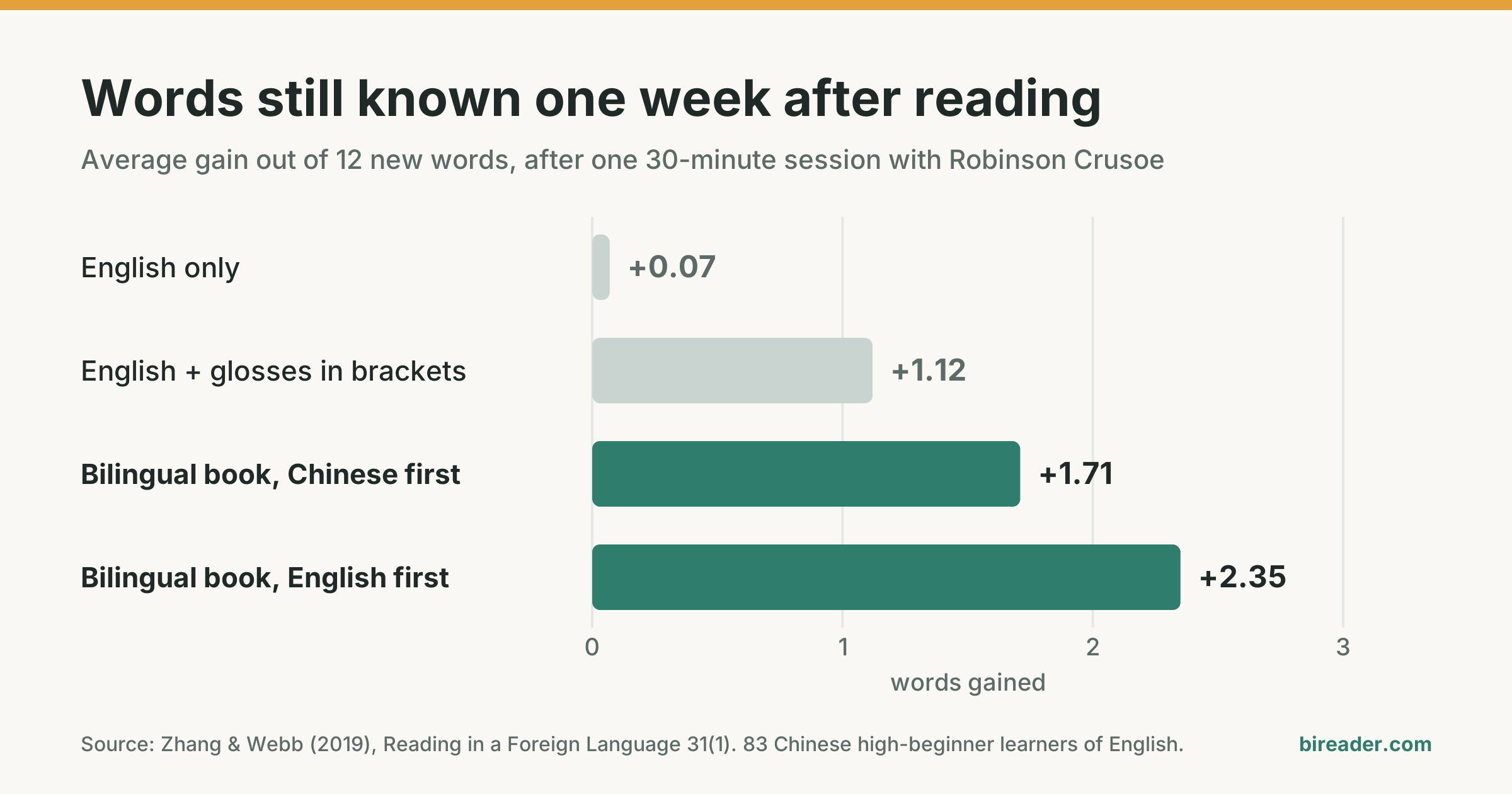
In 2019, Zhiying Zhang and Stuart Webb gave 83 Chinese students the first two chapters of Robinson Crusoe, in a simplified version for learners. The students were 17 and 18, at a high-beginner level, and each had 30 minutes to read.
They read it in one of four ways. One group got English only. One group got English with the Chinese meaning in brackets after each new word. Two groups got the full bilingual book: one read the English pages first and then the Chinese, the other read the Chinese first.
Nobody told them they would be tested on words. Afterwards, they had to translate twelve words from the story, such as shore, slave and leopard. Then they did the same test again a week later.
Right after reading, every group had learned something. A week later, the English-only group had kept almost nothing. They knew on average 0.07 more words than before they started. The bracket group kept about one. The bilingual groups kept about two, and the English-first group did best of all, with 2.35 words out of twelve.
Be careful with those numbers. This was one short session, twelve words, and groups of 15 to 24 students. The difference between reading English first and Chinese first was not big enough to be sure it was real. But the main result is hard to explain away: the readers with the full translation did not forget more. They forgot less.
So the translation does not wash words out of your memory. That is not the same as saying it cannot make you lazy.
Where the Laziness Actually Shows Up
The clearest evidence comes from a screen, not a page.
In 2022, Andi Wang and Ana Pellicer-Sánchez showed 112 Chinese learners of English a documentary. One group watched with two lines of subtitles at once: English on top, Chinese below. An eye tracker recorded where every glance went.
The eyes went to Chinese. Viewers spent more time on the line in their own language than on the English line. That is the laziness every teacher warns about, and here it was on a recording.
Then came the part that matters. The researchers checked which glances predicted learning. Time spent on the English target words did. Time spent on the Chinese translations did not. The translation helped people understand the film. The learning happened only when their eyes went back to the English word.
A later study by Wang found the same pattern from another angle. With two subtitle lines, viewers often skipped the English words completely.
Subtitles are harder than a page, because they disappear after a few seconds and you have little time to look back. On a page, you control the pace. But the lesson carries over. The danger is not that the translation exists. The danger is reading the wrong column.
Which raises an old question. Would it be better to take the translation away and make you work out each word yourself?
Why Working It Out Yourself Is Overrated
The idea behind that question has a name. In 2001, Batia Laufer and Jan Hulstijn proposed that words stick better when a task makes you search for a meaning and judge whether it fits. More effort, more memory. It is one of the most cited ideas in vocabulary research.
A Dutch researcher, Jan-Arjen Mondria, tested the simplest version of that idea in a study published in 2003. He gave 38 Dutch teenagers French words in helpful sentences, like remorquer in a sentence about a car pulling a caravan.
Some words they had to work out from the sentence, check in a word list, and then learn. For other words, the meaning was simply given, and they went straight to learning. Two weeks later, he tested them.
The hard way did not win. Students remembered 47% of the words they had worked out and 50% of the words they had been given. The hard way also took 27% more time. So per minute spent, being given the meaning was the better deal.
One detail in Mondria's data is more interesting than the main result. The cheapest learning in the whole study came from checking. Students learned about 0.51 words per minute while checking their guesses, and about 0.06 words per minute while guessing. And when a guess was wrong and then corrected, the word was remembered just as well as a word that was guessed right.
Mondria used single sentences and asked students to learn the words on purpose, which is not the same as reading a story for fun. But his result points the same way as the eye tracker. Effort alone is not what makes a word stick. Something else is.
The Look That Counts
In 2020, Akifumi Yanagisawa, Stuart Webb and Takumi Uchihara combined the results of 42 studies on glosses, the short translations printed next to hard words. Together, the studies included 3,802 learners.
Glosses helped, and not by a little. Right after reading, people who had glosses knew 45% of the new words, against 27% for people who read without them. On later tests, it was 33% against 20%. Glosses in the reader's own language worked better than glosses in the language being learned.
But the type of gloss mattered. The best kind was a small multiple-choice gloss, where the reader had to pick the right meaning from a few options. The weakest kinds were meanings dropped into brackets right after the word, and word lists at the back of the book.
An older study adds one more piece. In 1996, Hulstijn, Hollander and Greidanus had advanced Dutch students of French read a French short story. One group had glosses in the margin. Another group had a dictionary. The dictionary group learned fewer words overall, mostly because they hardly ever opened the dictionary. But the few words they did look up, they remembered better than the glossed ones.
Put these results side by side and one pattern stands out. This part is my reading of the studies, not a finding any of them states. The help works when it sends you back to the foreign word: when you have to choose, when you went looking on purpose, when your eyes return to the English after the Chinese. The help fails when it lets you take the meaning and move on, which is exactly what brackets after every word invite you to do.
Effort is not the active ingredient. Attention to the word is.
How to Read a Parallel Text Without Going Lazy
Start in the language you are learning. Read the paragraph in the target language first, all the way through, before you look across. The order made no clear difference in Zhang and Webb's short test, but it keeps your eyes where the learning happens, and their English-first group did come out on top.
Use the translation to check, not to read. When a word stops you, make a quick guess, then look across. If you were right, the word gets a little stronger. If you were wrong, you just did the most efficient learning in Mondria's study.
Always look back. This is the step people skip. After you find the meaning in the translation, return to the foreign word and read the sentence again with the meaning in mind. It takes two seconds. In the eye-tracking study, that look back was the only part that predicted learning.
Tap one word instead of reading the whole column. If only one word blocks you, you do not need the whole paragraph in your own language. A single word looked up on purpose is closer to the dictionary readers who remembered their few lookups well.
Watch which column you read first. If you notice that you read the translation first for most paragraphs, the story is too hard. You are reading a book in your own language with decoration on the side. Drop a level until the target language comes first again.
A parallel text is not a shortcut and not a crutch. It is a tool with a right way to hold it. Read the hard side first, cross over only when you need to, and always come back. Do that, and the translation stops being the thing that does your work and becomes the thing that checks it. Generate your first bilingual story at your level and try reading it target-first, looking across only to check.
Related reading:
- Guessing From Context: Why Most of Your Guesses Are Wrong
- Stop Translating in Your Head: How to Read Directly in a New Language
- Reading vs. Subtitles: Why Forty Hours of Netflix Won't Teach You a Language
Start reading bilingual stories for free
Start reading bilingual stories for freeNot sure of your reading level? Take the free CEFR test →