Screen vs. Paper: When Reading on a Screen Actually Costs You
Somewhere, probably on your phone, you read that screens make you understand less. Paper wins. Your brain was built for pages, and every hour on a screen makes things worse.
The research behind that claim is real. But when you look at what was actually tested, the screen problem is narrower than the headline and easier to fix. In one place, it is also more worrying for language learners than anyone tells you.
Try the method first: Generate your first bilingual story
What the Biggest Study Actually Found
In 2018, Pablo Delgado and three colleagues collected every study they could find from 2000 to 2017 that gave people the same text on paper and on a screen. No links, no videos, no pop-ups. The same words in two places, followed by a comprehension test.
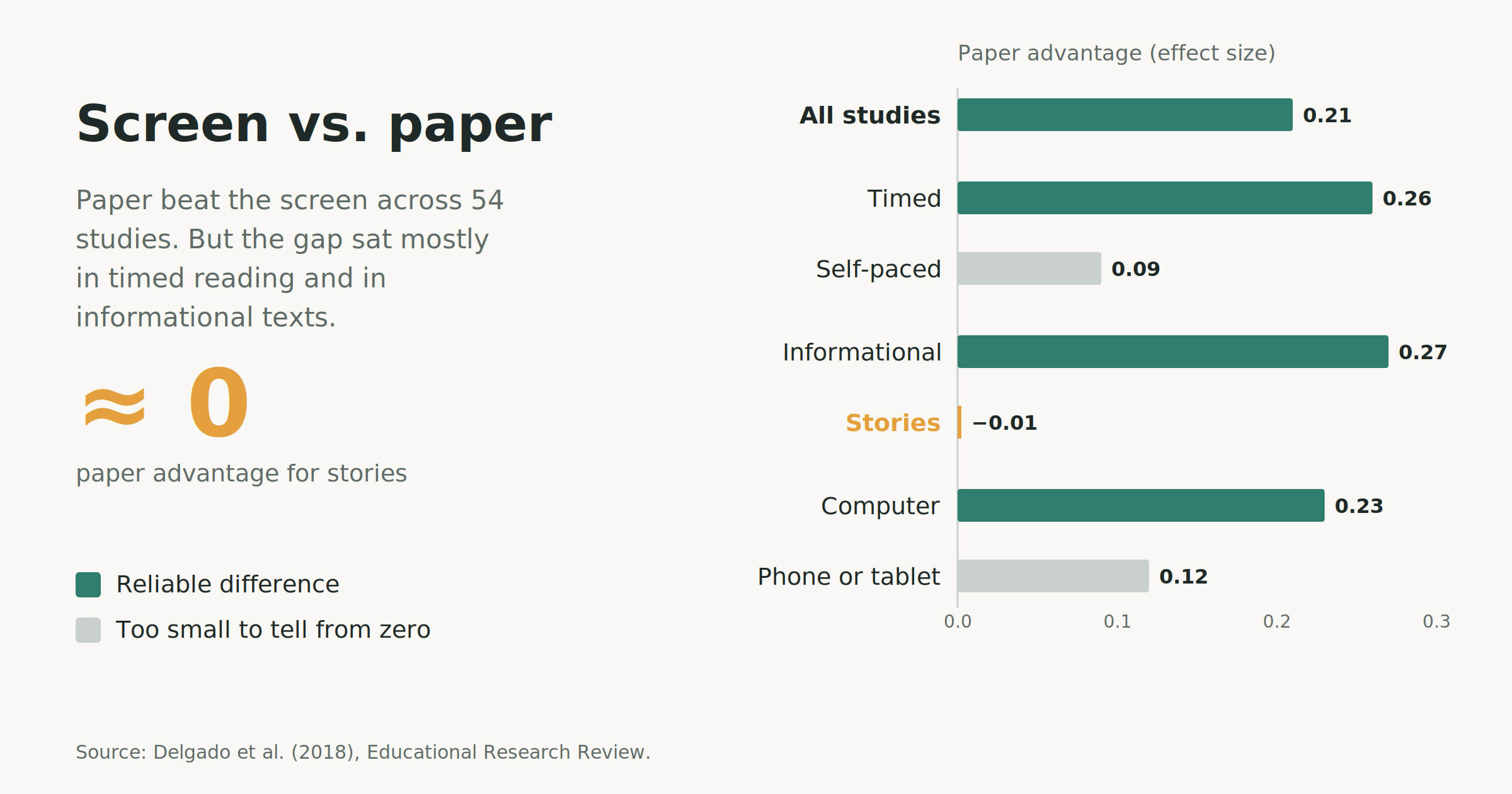
They ended up with 54 studies and 171,055 readers. Paper won. The average gap was small: an effect size of 0.21. The authors put that number in context. In primary school, it is about two thirds of the progress a child makes in reading comprehension in a whole year.
A year later, Virginia Clinton ran a separate analysis of 33 studies with 2,799 readers. Same direction, similar size.
Then came the part nobody expected. If screens were only unfamiliar, the gap should shrink as people grow up with phones. It did the opposite. In Delgado's data, the paper advantage grew a little with each year of publication. The authors are careful here, since the year a study came out is a rough stand-in for experience. Still, nothing in the data suggests that living with screens makes you a better screen reader.
So the headline is not wrong. But an average of 54 studies hides where the gap actually comes from.
Where the Screen Gap Lives
Delgado's team sorted the studies by how they were run, and two details made the biggest difference.
The first was the clock. When readers had a time limit, paper won by more, with an effect size of 0.26. When readers could take as long as they liked, the gap shrank to 0.09, too small to tell apart from zero.
The second was the kind of text. With informational texts, like textbook pages, articles and instructions, paper won clearly. With stories, the gap was zero. Clinton found the same split: a clear paper advantage for informational texts, and almost nothing for stories.
Picture two readers. Ana has twenty minutes to read a page about tax rules on her laptop before an exam question. Marek is reading a short story on his phone on the bus, with nowhere he needs to be. The research says Ana pays a real price for the screen. For Marek, it finds almost nothing.
There were weaker hints too. The gap looked smaller on phones and tablets than on computers, and smaller when readers did not have to scroll. Neither difference was strong enough to count as a finding. And only seven of the comparisons used stories alone, so the story result is promising, not settled.
Which leaves a puzzle. Why would the same screen be harmless for one kind of reading and costly for another?
Why Screens Make You Skim and Feel Sure You Did Not
The leading explanation has a plain name: the shallowing hypothesis. Most of what you do on a screen is quick. Messages, feeds, headlines. Over time, your brain learns that screen text is something to get through, not something to work on.
Rakefet Ackerman, one of Delgado's co-authors, has spent years testing this. In her studies, readers on a screen under time pressure did not just score lower. They were also more confident than readers on paper. They thought they had understood, and they had not. Clinton's analysis found the same pattern across studies: people judged their own understanding more accurately on paper.
That is the real cost. The screen does not block understanding. It makes skimming feel like reading.
Stories escape most of this because they pull you along. You follow a person, you want to know what happens next, and you read carefully without deciding to.
Most of it, not all. In 2019, Anne Mangen and colleagues gave 50 young adults a 28-page mystery story, about an hour of reading, either on a Kindle or in a paperback. On most tests, the two groups did equally well. But the paperback readers were better at putting events in the right order. The researchers think the hands help: on paper, you can feel how far into the book you are, and that feeling helps you place each scene in time. A short story avoids most of this problem. A long novel on a screen may not.
And all of this research shares one gap that matters a great deal for you.
What Changes When the Text Is Not in Your Language
Delgado's team made it a rule: every study had to test people in the language they use every day. So the biggest analysis says nothing directly about reading Spanish when your first language is English.
The studies that do test second-language reading disagree with each other. Two found no difference between paper and screen for Chinese and Korean learners of English. Another found a paper advantage for Chinese university students reading on phones.
The newest is the hardest to wave away. In 2026, Hyeran Ryu and Ekaterina Sudina tested 240 Korean eighth graders reading English, once on paper and once on a tablet. On paper, they answered 51% of the questions correctly. On the tablet, 46%. And the uncomfortable part: the stories did not escape. The gap was the same for narrative passages as for informational ones. It was also larger for the stronger readers, not the weaker ones.
Look at how the test was run, though. It had a 25-minute limit. The passages scrolled, with the questions beside them. Those are exactly the conditions where screens lose in first-language studies too. The readers were young teenagers, tested in a classroom. This is one study, not a verdict.
But it is enough to drop the comfortable version. "Stories are fine on screens" holds up in your first language. In a language you are still learning, nobody has shown it yet.
There is a reason it might be harder. Reading in a new language already uses much of your working memory just to recognize words and hold a sentence together. Anything that adds load, like a clock, a scroll bar or a notification, has less spare room to take from.
So should you print everything? No. The conditions that create the gap are mostly ones you control.
How to Read on a Screen Without Paying for It
Take the clock away. Time pressure was the strongest condition behind the screen gap. A streak timer or a goal like "five stories before bed" brings it right back. Read until the story ends, not until a timer does.
Make the story the only thing on the screen. In Ackerman's lab, treating a screen task as the main event instead of a warm-up closed much of the gap. Turn off notifications. One app, one story.
Write three words when you finish. In another of her studies, asking readers to note a few keywords that summed up each text removed the screen disadvantage, at least for people who already preferred screens. It takes ten seconds, and it makes you notice what you actually understood.
Test the feeling, not just the words. Screens make you overconfident, so do not trust the sense that you followed along. At the end of a paragraph, say in one sentence what happened. Then read the translation. If the two do not match, you were skimming.
Keep stories short, and save dense texts for paper. Short stories avoid the "where was I" problem from the Kindle study. If you need to study a grammar explanation or an exam passage, print it if you can. That is the kind of reading where paper wins most clearly.
The screen was never really the problem. The clock was, along with the habit of treating anything on a phone as something to get through. Take those away, choose a story over a textbook page, and most of the gap the studies found has nowhere to come from. What remains is a small, honest risk, and you can check for it yourself, one paragraph at a time. Generate your first bilingual story at your level, leave the timer off, and see which three words you write at the end.
Related reading:
- Reading Speed: The Skill Nobody Tells You to Train
- Fiction vs. News: What to Read When You're Learning a Language
- Daily Reading Habit: Why 15 Minutes a Day Beats Two Hours on Sunday
Start reading bilingual stories for free
Start reading bilingual stories for freeNot sure of your reading level? Take the free CEFR test →