Guessing From Context: Why Most of Your Guesses Are Wrong
"Guess the meaning from context." Every teacher says it. Every textbook has a page on it. It sounds like the skill that separates real readers from people who live inside a dictionary.
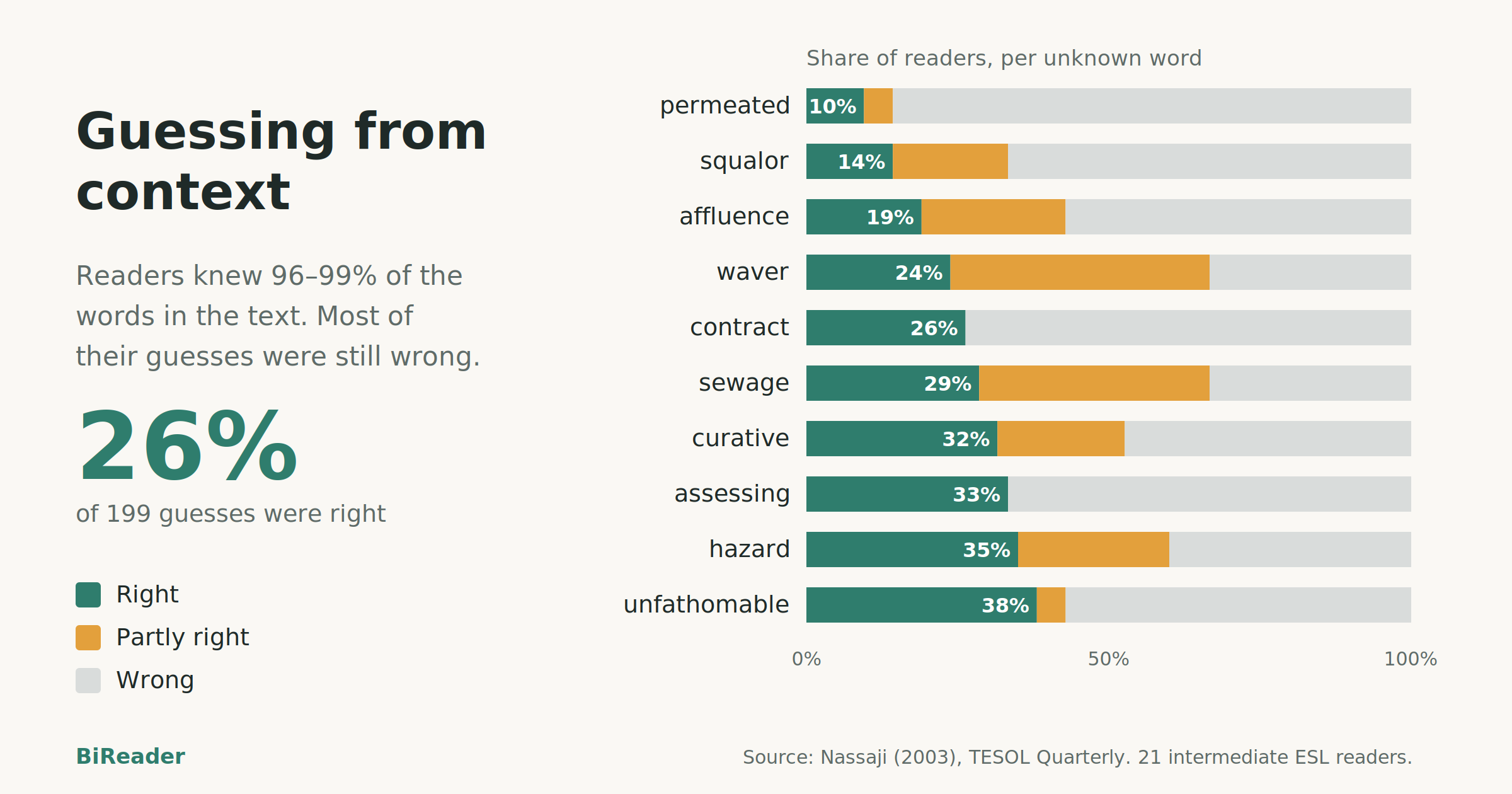
Then someone checked the guesses. Readers who already knew almost every word on the page got the new words right about one time in four. More than half the time, they were completely wrong, and they kept reading as if nothing had happened.
The advice is not useless. But it only works in conditions most learners never reach, and it leaves out the one step that makes it safe.
Try the method first: Generate your first bilingual story
What Happened When Someone Checked the Guesses
In 2003, Hossein Nassaji sat down with 21 intermediate learners of English, one at a time. Each of them read a short article about health in rich and poor countries. It was 374 words long. Every time they met a word they did not know, they said out loud what they were thinking.
The text was chosen with care. The learners knew between 96% and 99% of the words in it. That is close to the level most reading researchers call comfortable. If guessing from context works anywhere, it should work here.
It mostly did not. Out of 199 guesses, 51 were right. Another 37 were partly right. The other 111, more than half, were simply wrong. For no single word did more than 38% of the readers get the meaning right.
This was not a strange one-off result. Twenty years earlier, Marsha Bensoussan and Batia Laufer had tested the same question a different way. Context helped their learners with only about a quarter of the words.
So the problem is not that you are bad at guessing. Guessing is simply much harder than the advice makes it sound. And the way it goes wrong is not what you would expect.
Why You Guess From the Word Instead of the Sentence
One of the words in Nassaji's text was permeated. The sentence described a worker whose body was full of chemicals. Only 2 of the 21 readers worked out what the word meant.
One reader heard meat inside it and decided the word had something to do with meat and the body. Others turned waver into wave, and affluence into influence. None of them were careless. They did exactly what a brain does with a strange word: it looks for something familiar inside the word, finds it, and stops looking.
Laufer gave the worst version of this a name: deceptive transparency. Some words look as if you can take them apart, but you cannot. Infallible looks like in + fall + ible. Outgrow looks like "grow outside." Take them apart and you get an answer that feels clean, logical and certain. It is also wrong.
These are the dangerous words. A word you know you do not know makes you stop. A word you think you know lets you keep reading, with the wrong meaning in your head.
Nassaji's recordings also showed which habits paid off. The most common move was to repeat the word itself, again and again. When readers did that, their guesses were right about one time in four. Going back to read the whole sentence did better: 44%. Checking a guess against the rest of the paragraph did best, about two times in three. Nassaji is careful to say these are links, not proof of cause. But the direction is hard to miss. The answer is almost never inside the word. It is around it.
Which raises a question. If the context holds the answer, why do most learners fail to get it out?
When Guessing Really Works
It depends on how much of that context you actually understand.
In 1985, Liu Na and Paul Nation took a text and replaced some words with invented ones. In one version, one word in every 25 was unknown. In the other, one word in every 10. The words in the first version were easier to guess. The strongest learners guessed 85% to 100% of the invented words. The weakest guessed 30% to 40%.
One caution about those numbers: the learners were sorted into groups by how well they guessed, so part of that gap is built into the design. The finding about density is the solid part.
Nassaji saw the same pattern on a smaller scale. Even among readers who all knew more than 95% of the words, every extra unknown word in the text made a correct guess less likely.
Put simply: context is made of words. Every word you do not know is a clue you cannot read. When one word in fifty is new, the other forty-nine all point at it. When one word in ten is new, the clues are full of holes, and your brain fills the holes with meat and waves.
That is why the usual advice is backwards. It is given most often to beginners reading texts that are too hard for them, which is exactly where guessing fails most. It works best for readers who barely need it.
So should you stop guessing? No. What happens after a wrong guess tells a different story.
A Wrong Guess Is Not the Problem. An Unchecked One Is.
In 2017, Irina Elgort gave 47 Chinese learners of English 48 new words. Each word appeared in three helpful sentences. The learners typed a guess for each word, and then they read a short dictionary definition of it.
With sentences that helpful, their guesses were right about 62% of the time. The interesting part came later.
A wrong guess did hurt a little. After a wrong guess, learners were somewhat less likely to remember the meaning than after a right one. But a wrong guess was no worse than no guess at all. For learners with larger vocabularies, the cost of a wrong guess disappeared completely. The only choice that stayed costly at every level was not guessing.
A second test measured something deeper: how quickly the brain recognized each new word, without the learner being aware of it. Here, wrong guesses did no measurable harm at all.
One detail matters more than any other. Every learner in that study checked the definition after guessing. The wrong guesses were corrected.
A study by Shana Carpenter and colleagues, with learners reading German, shows why that step matters. When wrong guesses were corrected, learners rarely repeated them later. When they were not corrected, most learners gave the same wrong answer again on the test.
That is the whole difference. A guess followed by a check is useful work. The guess makes you look hard at the sentence, and the check fixes what the sentence could not tell you. A guess with no check is how permeated stays "something about meat" for years.
One more honest number. Even in Elgort's study, with good sentences, active guessing and a definition afterwards, learners could later explain the meaning of only about 15% of the words. Guessing is how a word starts. It is not how a word is finished.
How to Guess and Check While You Read
Finish the sentence before you guess. Most wrong guesses come from stopping at the word. The answer usually comes after it.
Be most careful with words that look familiar. If a new word seems to contain a word you know, like meat, wave or fall, treat that as a question, not an answer.
Make a specific guess. Not "something bad," but "probably means filled with." A vague feeling cannot be checked. A specific guess can.
Then check, right away. In a bilingual story, the check is one line down. Cover it with your thumb if you need to. Guess first, then look. If you were right, the word gets a little stronger. If you were wrong, you find out before the wrong meaning has time to settle.
Count your checks. If you need to check a word in almost every sentence, the text is too hard for guessing to work. The fix is an easier story, not a better strategy. Liu and Nation's easier text had one unknown word in every 25, which is roughly one in every two sentences.
Guessing from context is a real skill. It is also slow to build, unreliable at the start, and far safer when you have a way to check. You do not need to stop guessing. You need to stop trusting a guess you never tested. Generate your first bilingual story at your level, guess each new word before you look down, and see how often the second line agrees with you.
Related reading:
- Choosing Your Reading Level: How to Tell If a Story Is Too Easy or Too Hard
- Extensive vs. Intensive Reading: Why Volume Beats Analysis
- Cognates: The Vocabulary You Already Own
Start reading bilingual stories for free
Start reading bilingual stories for freeNot sure of your reading level? Take the free CEFR test →