Collocations: Why You Know Every Word and Still Sound Wrong
You wrote strong rain. Every word was correct. Every word was in the right place. Your teacher crossed it out and wrote heavy.
You ask why. No rule comes back. Rain is heavy. Wind is strong. Traffic is heavy, a swimmer is strong, and nobody can tell you why English divided the weather up this way.
This mistake does not feel like a mistake. You did not forget a word. You did not break a grammar rule. You wrote a sentence that is completely legal, and that no native speaker would ever write. The only feedback you get is: we just don't say it like that.
What you are missing is not a word. It is the company that word keeps — which words appear next to it, how often, and which reasonable alternatives everyone quietly refuses. These pairs are called collocations. They are most of what separates correct English from English that sounds like a person wrote it.
Try the method first: Generate your first bilingual story.
Half of What You Read Is Already Made
Start with how much of the language this covers.
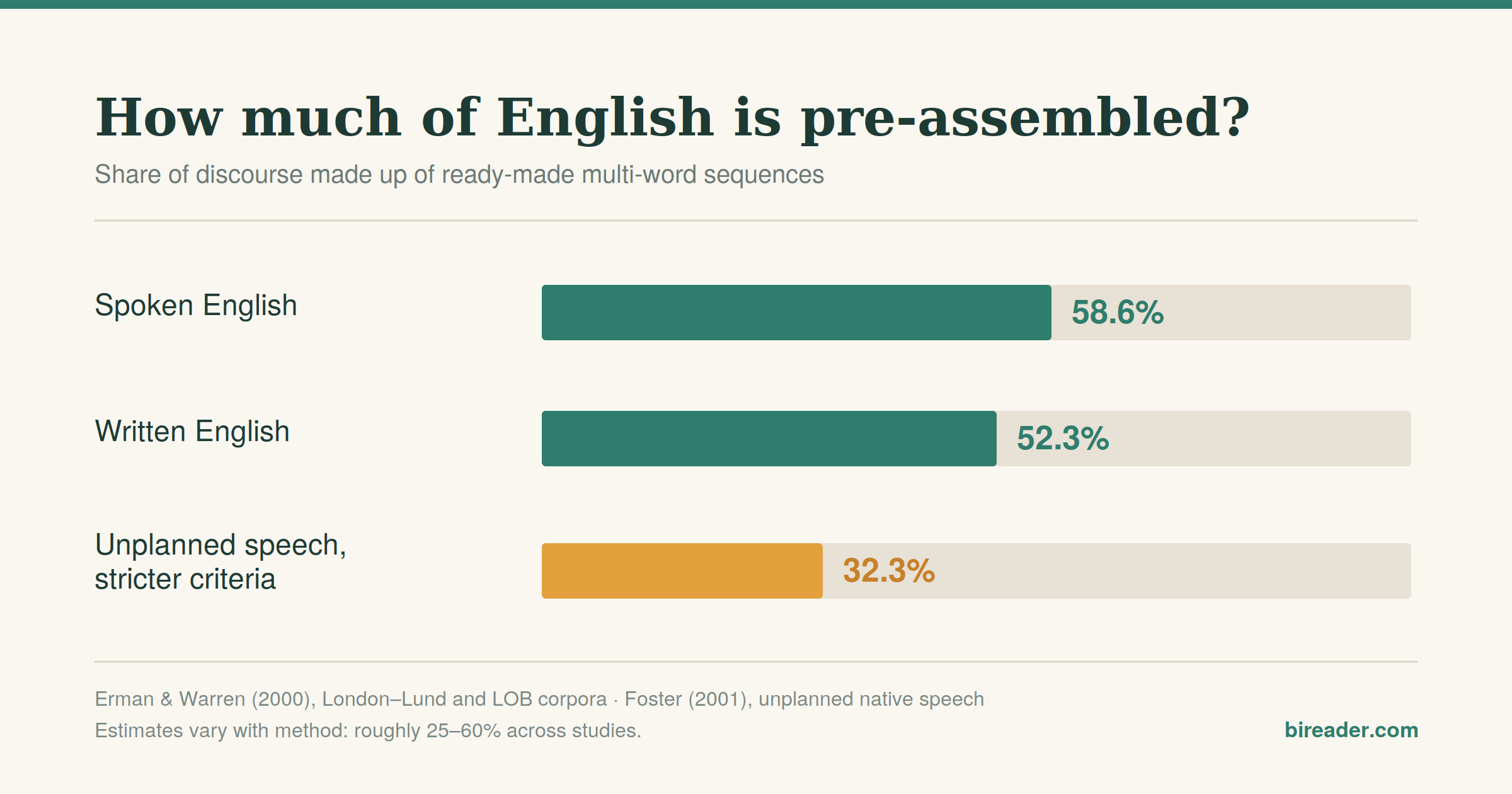
In 2000, two researchers, Britt Erman and Beatrice Warren, went through samples of spoken and written English. They counted how much of it came in ready-made combinations — phrases that arrive whole, instead of being built one word at a time. Their answer: 58.6% of speech and 52.3% of writing.
More than half of the language you are learning arrives in pieces bigger than a word.
Other researchers count more strictly and get smaller numbers. Pauline Foster's raters judged 32.3% of everyday, unplanned speech to be ready-made. Across different methods, the estimates run from about a quarter to about sixty percent. Take the smallest number, and nothing important changes. A third of what you read is a phrase somebody else built first. Your job is to recognize it, not to build it.
John Sinclair called this the idiom principle. A speaker keeps a large store of ready-made phrases, and only uses grammar rules when no phrase fits. You do not build have a shower out of have and shower. You pull it out whole, the same way you pull out a single word.
So the hard part of a language was never the individual words.
Your First Language Chooses the Wrong Partner
Iryna grew up speaking Ukrainian. She writes strong rain, because сильний дощ is strong rain. She writes accept a decision, because прийняти рішення is accept a decision. Both translations are exact. Both sentences are wrong. And nothing warns her, because her own first language produced the error.
Once you have a first language, collocations split into two groups.
Some match word for word between your language and English. You get those for free, and you never notice the gift. Some do not match. That is where everything goes quietly wrong.
Junko Yamashita and Nan Jiang tested this. They asked three groups to judge whether English phrases sounded right: native speakers, Japanese learners studying in Japan, and Japanese speakers living in an English-speaking country. Both learner groups were slower, and made more mistakes, on the phrases that do not match Japanese. The group living abroad did better overall — and still made more mistakes on those same phrases. Living inside the language made the gap smaller. It did not close it.
Batia Laufer and Tina Waldman found the same thing in writing. They studied Hebrew speakers at three levels of English. Every group used far fewer verb-noun collocations than native writers did. The errors did not disappear at the advanced level. About half of them came from the first language. Of 47 errors that appeared again and again, 42 were direct word-for-word translations.
Advanced learners do not grow out of this. So what were all those years of study doing instead?
Word Lists Teach You the Wrong Unit
A flashcard tells you that decision means решение. It tells you nothing about which verb goes with it. And the verb is the part you will get wrong.
Philip Durrant and Norbert Schmitt compared academic writing by native and non-native writers. The learners were not short of phrases. They were short of the right ones. Non-native writers leaned on a small set of very common combinations, and used them again and again. Native writers reached more often for rarer pairs that stick together strongly. Rare combinations made up 48% of what native writers produced, and 38% of what the learners produced.
The result is writing that never breaks a rule and never sounds like anyone. Good example. Very important. Correct every time, and completely flat.
You cannot get this from a list. The information is not inside the word. It is in the pattern around the word — which neighbours turn up, which ones never do, how strongly they pull together. The only way to learn a pattern is to meet the same word in many different sentences.
That is a description of reading, delivered more slowly than anyone would like.
What Reading Does, and How Slowly
Stuart Webb, Jonathan Newton and Anna Chang ran the clearest test of this. They took one graded reader and made four versions of it. In each version, the same 18 collocations appeared a different number of times: once, five times, ten times, fifteen times. Then 161 Taiwanese university students read one version while listening to it, and took a surprise test afterwards.
Repetition mattered. One meeting with a phrase did almost nothing. Five was not much better for learning the written form. At fifteen, the gains were large. Students who met face facts or blow your nose fifteen times inside a story could recognize them later, and often produce them, without being told to study anything.
Then Ana Pellicer-Sánchez ran a study that complicates the picture. Forty-one learners read a story with six collocations built around invented words. The phrases appeared either four times or eight times. A week later, the learners recognized the phrase about 40% of the time, and could recall it about 10% of the time. That is real learning from one reading, but it is thin. And the eight-times group was not clearly ahead of the four-times group.
So here is the honest summary. Reading does teach collocations. It teaches them slowly, phrase by phrase, and repetition helps in most studies but not in all of them. One story will not fix strong rain. A hundred stories will fix it, along with thousands of other pairs you will never notice yourself fixing.
How to Read So the Pairs Stay
If repetition is what does the work, then the decision that matters is what you read next. Not how hard you concentrate while you read it.
Stay in one world for a while. Six stories set in restaurants will give you make a reservation, take a seat and leave a tip again and again, without anyone planning it. Move from a restaurant to a spaceship to a courtroom, and every phrase drops back to one meeting.
Read the same story twice. The first time, all your attention goes to the plot. The second time, you have attention left over. That spare attention is what notices heavy next to rain twice, and strong never.
Turn the audio on if you have it. Studies that compare ways of reading keep finding that reading while listening beats reading alone for picking up phrases. The phrase arrives with a rhythm, and the rhythm helps your brain treat it as one thing.
Use the translation as a tool, not as a crutch. Where the second line matches word for word, there is nothing new to learn: your first language already gave you that pair. Where it does not match — where tener hambre becomes be hungry instead of have hunger — you are looking at the kind of phrase that survives ten years of study and then catches you in an email. Slow down there. Not on the new words. On the familiar words in an unfamiliar order.
And if you write anything down, write down the pair. Heavy rain, not rain. A single noun is a card you will answer correctly for years, while you keep writing the wrong sentence.
Nobody taught you that rain is heavy and wind is strong. You met the phrases often enough that the wrong version started to sound wrong, and that feeling is the whole skill. You can build the same feeling in a second language. It just needs more material than a course can give you, and it needs that material shaped like stories instead of lists. Generate your first bilingual story at your level, and watch for the lines where the translation stops matching word for word. Those are the phrases that were going to catch you anyway.
Related reading:
- The Pickup Rate: How Few Words a Book Actually Teaches You
- Stop Translating in Your Head: How to Read Directly in a New Language
- Listening While You Read: Why Pairing Audio With Stories Builds Fluency Faster
Start reading bilingual stories for free.
Start reading bilingual stories for freeNot sure of your reading level? Take the free CEFR test →