Age and Language Learning: Why Adults Learn Faster at First
You have probably been told you started too late. A child would pick up Spanish in a few months, and you, at thirty-five, are pushing against a window that closed years ago.
Put a seven-year-old and an adult in the same country, test them both a few months later, and the adult is usually ahead.
The research behind "younger is better" is real. It just measures something different from what you are doing right now. It measures where people end up after ten years. In the first year, the year you are actually in, the advantage runs the other way.
Try the method first: Generate your first bilingual story
What Happened When Children and Adults Learned Dutch Side by Side
In a study published in 1978, Catherine Snow and Marian Hoefnagel-Höhle followed English speakers who had just moved to the Netherlands. The youngest were three. The oldest were adults. They were picking up Dutch mostly from everyday life, at school, at work and in the shops, and the researchers tested every age group three times during the first year.
The early results are the opposite of the folk belief. In the first few months, the 12- to 15-year-olds and the adults made the fastest progress. The three- to five-year-olds scored lowest on every test.
By the end of the year the picture had shifted. The 8- to 10-year-olds and the teenagers had the best control of Dutch, and the children were catching up with the adults, or passing them, on several measures. The youngest group still trailed everyone.
A companion study by the same pair looked at pronunciation, the one area where children are supposed to be untouchable. The older learners started with better pronunciation. The age differences had disappeared by four or five months. By ten or eleven months the younger children were better at some sounds, but there was still no overall difference between the age groups.
So the adults were fast out of the gate, and the children started closing in later. That is a race with two phases. Almost all the advice about age describes only the second one.
Why "Children Learn Faster" Feels So Obviously True
In 1979, Stephen Krashen, Michael Long and Robin Scarcella drew the distinction that clears up most of the confusion: rate versus ultimate attainment. Rate is how fast you progress early on. Ultimate attainment is how far you eventually get. Older learners win on rate. Younger starters, given years of immersion, win on attainment.
The studies everyone quotes measure attainment. In 1989, Jacqueline Johnson and Elissa Newport tested Korean and Chinese speakers who had lived in the United States for at least ten years. Those who arrived between the ages of 3 and 7 scored like native speakers on a grammar test. Those who arrived later did worse the later they came, and the adult arrivals scored lowest, with huge differences between individuals.
In 2018, Joshua Hartshorne, Joshua Tenenbaum and Steven Pinker analysed an online grammar quiz taken by 669,498 native and non-native speakers of English. Their model put the end of peak grammar-learning ability at about 17.4 years, followed by a steady decline.
Not everyone accepts the shape of that curve. A 2021 reanalysis argued the same data fit a gradual decline better, and Hartshorne published a rebuttal in 2024. What nobody seriously disputes is the basic point: people who start as adults rarely end up indistinguishable from native speakers.
But look at what is being tested. Native-like, after a decade. That is a good question for a linguist and probably not yours. You want to read a novel, follow a meeting, argue with a landlord. The research on that goal is the research on rate, and it favours you.
There is a catch, though, and it turned up in a school.
What Barcelona's Classrooms Showed About Hours, Not Age
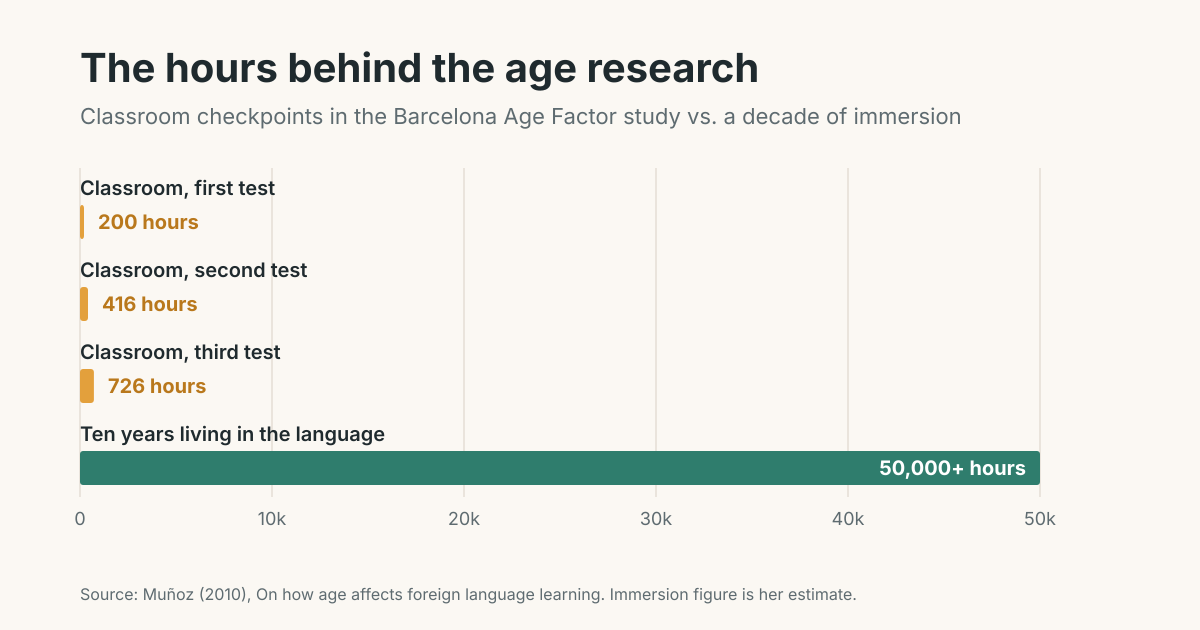
Immigrant studies have a hidden ingredient: the language is everywhere, all day. Carmen Muñoz wanted to know what happens to the age effect when it is not. Her Barcelona Age Factor project followed Spanish-Catalan bilingual students learning English at school, who had started at 8, 11, 14, or 18 and older. The age comparisons used only learners with no English outside class. The groups were tested after 200, 416 and 726 hours of instruction.
The older starters generally did better at every testing point. The younger starters never overtook them during the study. At most, the gaps shrank or stopped being significant on the less demanding tasks, such as listening comprehension and fluency.
Muñoz's explanation is about input, and her arithmetic is hard to argue with. She estimates that ten years of living in a country gives you more than 50,000 hours of the language. At four one-hour lessons a week, the same amount would take more than two centuries.
The chart at the top of this post shows the gap: three classroom checkpoints, and the immersion figure behind the studies everyone quotes. The child's slow, effortless absorption, the sponge everyone talks about, needs that ocean. A school gives it a damp cloth.
Without massive input, the child's long-term edge never arrives. What is left is the older learner's rate advantage, and that advantage is only worth what you feed it.
What You Have That a Seven-Year-Old Doesn't
Muñoz credits the older learners' edge to cognitive maturity. You can use explicit learning: noticing a pattern, asking why, applying an explanation. Someone can tell you that German sends the verb to the end of a subordinate clause, and you will start spotting it tomorrow. A seven-year-old has to meet it a few thousand times.
You can also read. That sounds trivial until you look at the Dutch study again. The three-year-olds could not read Dutch, or anything else. Every word they learned came through their ears, at whatever speed adults chose to talk to them. You can sit down with a story and take in several thousand words in half an hour, at your own pace, with the meaning beside you.
That link between reading and the adult rate advantage is my inference. None of the studies above tests it directly. But it is hard to see how being able to read would not help.
What you lost is real too. In 2000, Robert DeKeyser tested 57 Hungarian-speaking immigrants on English grammar. Very few of those who arrived as adults scored within the range of those who arrived as children, and the few who did had high verbal analytical ability. For the child arrivals, that ability made no difference.
DeKeyser's reading is that children absorb structure without thinking about it, while adults lean much harder on analysis. You still pick up patterns from exposure, as grammar through reading describes. But your analysis is doing more of the work, and it needs something to analyse.
Picture Daniel, 41, who moves to Lyon with his nine-year-old daughter. By Christmas he can read the letters her school sends home, and she cannot. By the following Christmas she is correcting his vowels on the walk to school. Both are exactly what the research predicts. Only one of them is a reason for Daniel to stop.
How to Use the Head Start
The rate advantage is a head start, not a guarantee. It is worth exactly the input you put behind it.
Stop measuring yourself against native-like. That benchmark comes from immigrants after a decade in the country. A better one is whether you can read something today that you could not read in spring.
Get your hours somewhere other than class. The Barcelona learners had 200 hours by the first test. Twenty minutes of reading a day comes to about 120 hours a year. An hour a day passes the study's 726 hours in two years. Reading is the cheapest way an adult can buy volume, which is why reading a lot of easy text matters more for you than it ever did for a child surrounded by the language.
Let yourself notice. Your explicit edge is wasted if you read like a sponge. When a structure keeps coming back, look it up after you have met it a few times. Read first, label second.
Read at a level you can move through. The adult advantage works through understanding. A text you have to decode word by word gives your analysis nothing to work with and gives you very few hours of real input.
The window people warn you about is real, but it is the window to sounding as if you were born there. The one that matters this year, understanding more each month than the month before, is wide open, and you start it ahead of the children. Generate your first bilingual story at your level and spend the head start on something you would read anyway.
Related reading:
- Why Children's Books Won't Teach You a Language
- Grammar Through Reading: Why Rules Don't Stick but Patterns Do
- Extensive vs. Intensive Reading: Why Volume Beats Analysis
Start reading bilingual stories for free
Start reading bilingual stories for freeNot sure of your reading level? Take the free CEFR test →