The Pickup Rate: How Few Words a Book Actually Teaches You
In 2003, two researchers took a good novel and broke it on purpose.
They wanted to know how many words you really learn from reading a book. Nobody had a clean answer, because you cannot test someone on words without telling them which words to watch. So the researchers cheated. They picked twenty-five ordinary words in the story and changed the spelling of every one.
In the book they handed out, the word for house was windle. Money was mear. Night was cadle. Dead was molden. Beautiful was smorty. And yes — the word yes — was yoot.
Try the method first: Generate your first bilingual story
The Book Where Yes Was Yoot
Imagine being handed this book. You are a university student in western Japan. Your English is good. Someone gives you a short novel written for learners and tells you to read it and enjoy it. Nothing is marked. Nobody says the book has been changed.
So you read. Fifty-six minutes, about a hundred words a minute. Afterwards you say it was easy, and it was: you already knew ninety-six percent of the words on the page. Partway through, a few readers say there seem to be a lot of strange words in this story. They are told to keep going.
Then come the tests. There are three, and each one is harder than the last.
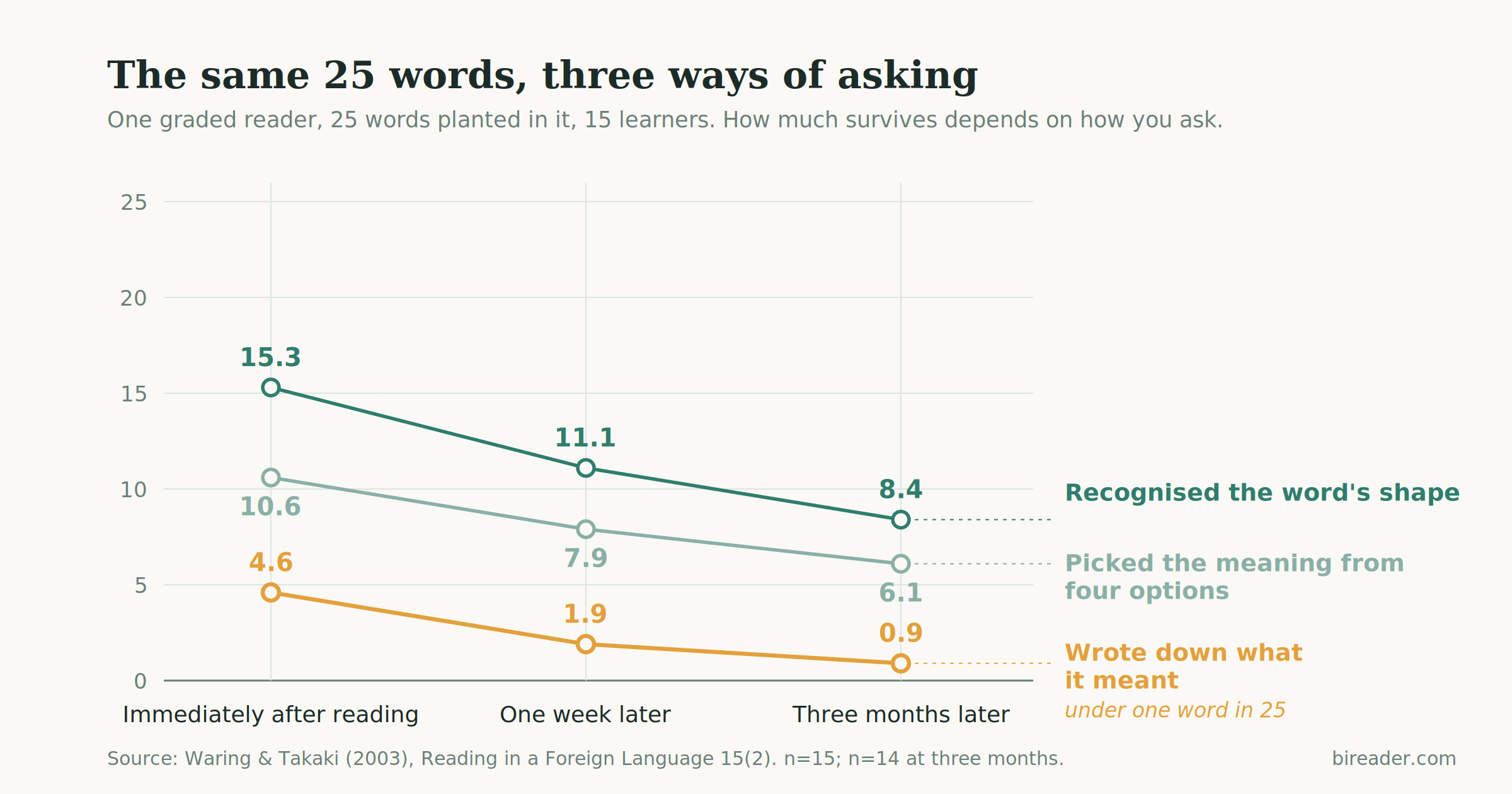
Circle the words you saw. Out of twenty-five, you get 15.3.
Here is a word and four possible meanings. Choose one. You get 10.6.
Here is a word. Write down what it means. You get 4.6.
Three months later, with no warning, they test you again. Recognising the words is still fairly easy: 8.4. The multiple-choice score drops to 6.1. And the last test — no options, no help, the test closest to real reading — comes back at 0.9.
Less than one word. From a whole book.
The researchers put their finding in one short sentence. On average, one new word from one hour of reading.
The Claim That Reading Is Enough
That number is a problem for a very popular idea.
Stephen Krashen has argued for decades that reading does not just help your vocabulary. He says it is enough on its own. Read enough, and reading will build your second language for you, with no studying at all. Every time someone tells you to relax and read more and it will come, you are hearing his idea.
Other researchers thought this sounded too easy. So they counted.
Start with how often a word has to appear. A word needs to show up about eight times before you have a fifty-fifty chance of even recognising it three months later. To learn what it means, the usual minimum is twelve. So where do you find twelve?
Take the whole Oxford Bookworms library. Fifty-four books, six levels, 377,576 words. Read every one of them. You will meet nearly all of the third-thousand vocabulary somewhere along the way. You will meet about half of it often enough to learn it.
Fifty-four books. Half the words. And that is the good case, using a library built for learners.
Read a shelf, and you meet most of it once.
The Tests Were Wrong Both Ways
But the tests were lying, and not only in the way you would expect.
Look at those three scores again. Right after reading, the multiple-choice score was more than twice the write-it-down score. Three months later it was seven times higher. Same people. Same words. Same afternoon. The only thing that changed was how easy the question was.
So every happy number from a multiple-choice study is worth about half of what it says.
The pessimists win, then. Except somebody built a test that could see smaller changes.
Instead of asking do you know this word, she asked learners to rate every word from zero to three. No idea. Not sure. I think so. Definitely. Then she watched how the ratings moved as people read the same text again and again.
In one round, 44 words out of 300 climbed all the way to definitely. A normal test would report those 44 and stop there. But another 56 words moved a little way up: from nothing to a guess, from a guess to a fair idea. A normal test scores every one of those as zero. A few words even moved back down, which is either forgetting, or a wrong guess being dropped.
The researcher who had just spent twenty pages arguing against Krashen looked at this and agreed at once. There is probably twice as much learning going on as anyone can measure.
So both sides had been counting the wrong thing for twenty years.
Meaning Arrives Last
The right thing to count showed up in a different study. One man read French for a month. Afterwards, researchers interviewed him about 133 words — not only what each word meant, but how it was spelled and how it worked in a sentence.
Two-thirds of those words had improved in some way. Two-thirds. That is nothing like one word an hour.
But look at the order. Spelling improved most. Grammar came next, things like which article a noun takes. Meaning came last, and improved least.
That changes everything above it. A word is not a switch you flip. It is a shape first. Then a sound. Then a set of habits inside a sentence. Then the words that usually sit next to it. And last of all, a meaning.
Ana meets sacudir for the fourth time in a Spanish story. She still cannot tell you what it means. She would score zero on every test in that Japanese experiment, and the score would be right. But her eye no longer stops on the word. That is a real change in her, and no test in the field would see it.
Read enough and the meaning does arrive. Advanced learners who read a whole novel remembered 84 percent of the words they had met more than ten times.
One word per hour was never how fast you learn. It is how fast words finish.
You Are Buying a Shelf, Not a Book
So here is the bill. To meet the second thousand most common words twelve times each, you need about 200,000 words of reading. To do the same with the ninth thousand, you need three million, or around twenty-five novels. If you learn about a thousand new word families a year, that is your real budget.
Which means your only enemy is the cost of one meeting with a word.
Forty minutes on one paragraph. Nine dictionary tabs. A sentence so long you lose the subject and go back to the start. Each of those is reading you did not do, and reading you did not do is a meeting that never happens. The stops are the whole problem.
A bilingual story removes them. The meaning is already there in the next column. An unknown word costs you a glance, not a trip, and the sentence in your head survives it. Generate your first bilingual story at your level and see how far you get before anything really stops you.
Stop grading yourself on what a book taught you. That number was always going to look bad, in any language, for any reader. It only counts the words that finished while you were watching. The eleven meetings before the twelfth do not show up anywhere. You will never feel a word being learned. You will just be reading, some evening months from now, and go straight past it.
Related reading:
- Extensive vs. Intensive Reading: Why Volume Beats Analysis
- Why Rereading the Same Story Beats Reading a New One Every Time
- The Forgetting Curve: Why New Words Vanish in 24 Hours — and How Reading Interrupts It
Start reading bilingual stories for free
Start reading bilingual stories for freeNot sure of your reading level? Take the free CEFR test →