Topic Interest: Why Boring Texts Teach You Fewer Words
You read the whole text. It was about water treatment, it was at your level, and you looked up five words along the way. You understood all of it.
Two days later you cannot remember one of those five words. The words were not especially hard. The text was boring, and boredom does more than make reading feel slow. It changes how many words you keep.
Most advice treats interest as a pleasant extra: read what you enjoy, because you will stick with it. That is true, and it undersells the effect. When researchers held everything else steady, the interesting text taught more words, and the difference was still there a month later.
Try the method first: Generate your first bilingual story
What Happened When Students Read One Boring Text and One Interesting One
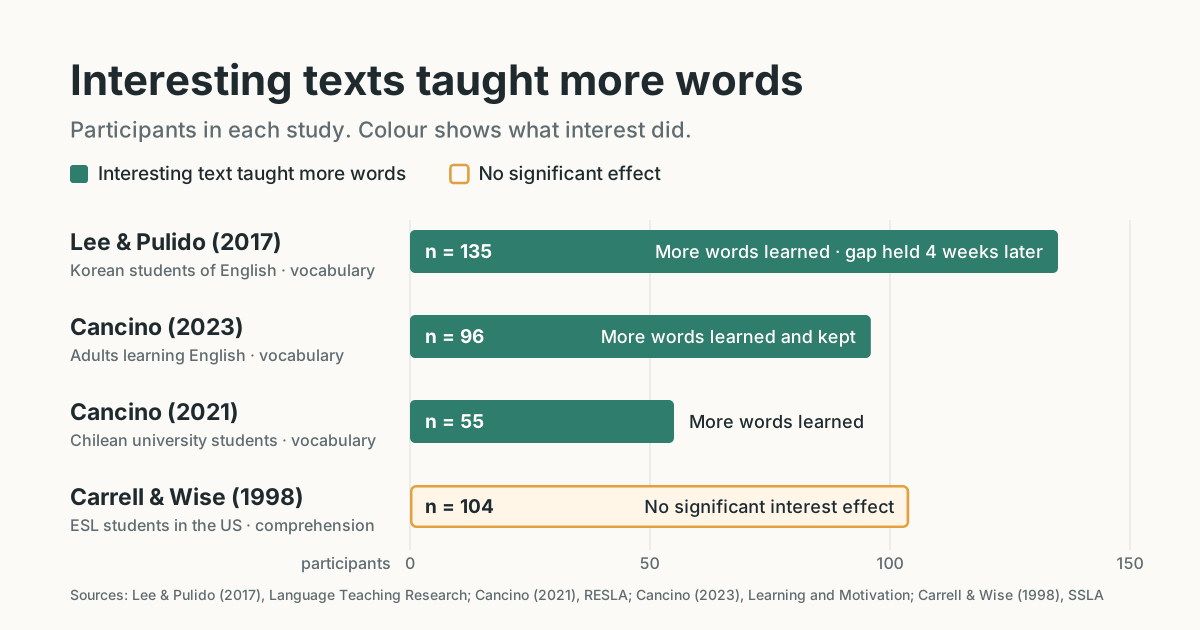
In a study published in 2017, Sunjung Lee and Diana Pulido gave 135 Korean students of English two short factual articles. One was on a topic the students found interesting. The other was on a topic they did not.
The researchers made the two texts equal in every other way they could. Both topics were familiar, so neither text gave a background-knowledge advantage. The new words in each text were matched: the same mix of nouns, verbs and adjectives, the same word lengths, the same balance of concrete and abstract. Two weeks before reading, the students took a test on all 30 target words, so the researchers knew which ones were really new.
After reading came the surprise tests. Do you recognise this word? Can you pick its translation? Can you write the translation yourself? Four weeks later, the students took them all again.
The interesting text won. Students learned significantly more new words from it, and four weeks later the gap was still there.
One detail makes the result hard to wave away. The stronger readers learned more words overall, as you would expect, but the boost from interest was the same for strong and weak readers. You do not need to be advanced before your choice of topic starts to matter.
One study is one study. Two more, run in Chile by Marco Cancino, found the same direction. In 2021, 55 university students learned more words from the text they found interesting. In 2023, with 96 adults and an online dictionary at hand, Cancino found the same result on every test and at every delay: more words learned, more words kept.
So interest helps. The harder question is how. You meet new words in both texts. What does your brain do differently with them?
Why an Interesting Text Teaches More Words
Cancino's 2023 study had a clue built into it. Readers could look words up as they went, and the researchers recorded every lookup.
When the text was interesting, a larger share of the words people learned were words they had looked up. Interest did not only make readers feel better about the text. It changed what they did when they met a word they did not know. They stopped and checked it.
Picture Daria reading two stories in Spanish. One is about a football club on the edge of bankruptcy, and Daria follows football. The other is about the history of a railway timetable. In the football story she meets deuda, debt, in the second paragraph. The whole plot turns on it, so she checks it. In the railway story she meets horario, decides it is probably something to do with hours, and moves on. She is not lazy. She just does not care enough about the sentence to care about the word.
An older study from educational psychology points the same way. In 2002, Mary Ainley, Suzanne Hidi and Dagmar Berndorff had Australian and Canadian students read four factual texts and tracked what happened along the way. Interest in the topic predicted how students felt while reading. How they felt predicted whether they stuck with the text. And sticking with it predicted what they learned.
Put the two findings side by side and you get a simple chain: interest keeps you in the text, and it makes you check the words that matter. That chain is my reading of the studies, not something any one of them proves alone. But it fits what the parallel-texts research found: words stick when your attention goes back to the word. Interest is one of the few things that sends it there without you having to force it.
That sounds like a tidy story. The evidence is less tidy.
Where the Evidence Is Weaker Than It Sounds
Start with who was tested. All three vocabulary studies tested people learning English, reading short factual articles, each study in a single country. Nobody has yet tested this with someone reading a novel in Italian for a month. The direction is consistent across all three. How big the effect would be for you, these studies cannot say.
Then there is a study that did not find it. In 1998, Patricia Carrell and Teresa Wise tested 104 students of English at an American university. Each student read texts covering every combination of high and low interest with high and low background knowledge, then answered comprehension questions.
Interest pointed the right way, but the effect was not significant. Neither was the effect of background knowledge. The authors suggest the two were tangled together, and that this tangle may have hidden the effect of each one on its own.
That study measured comprehension, not vocabulary, so it does not contradict the other three directly. It is still a useful warning. You are usually interested in things you already know about, which makes interest hard to separate from knowledge. That is exactly why Lee and Pulido made both of their topics familiar.
One more pattern turns up in three separate places. In Lee and Pulido's study, boys learned fewer words than girls from the boring text. Carrell and Wise found that male readers were more affected by interest than female readers. And a 1993 review of 21 studies on interest and school achievement found that the link between the two was stronger for male students.
None of these studies explains why. Some readers may simply be less willing to push through a text that bores them. Whatever the reason, if you recognise yourself in that description, choosing what you read is not a luxury. It is most of the job.
Which raises the obvious question. If interest matters this much, can it make a hard text easier?
Can Interest Make a Hard Text Easier?
Only up to a point.
Interest does not change the words on the page. If a text has three unknown words in every line, you will not follow it, however much you love the topic. Curiosity can carry you through some friction. It cannot supply meaning you do not have. Interest makes a text at your level teach more. It does not turn a text above your level into one at your level.
There is a trap on the other side, too. Marek likes chess, so he decides to read nothing but chess. For a few weeks it works beautifully. The same words keep coming back, and soon he knows them cold. Then he notices that he can explain an opening in Polish and cannot describe his own kitchen. Interest chose his topic. It did not choose the vocabulary he will need on Monday morning.
The fix is not to drop the interest. It is to let ordinary life into the topics you care about. A story about a chess tournament still has a hotel, a train, a bad dinner and an argument with a roommate.
How to Choose What You Read
Use the own-language test. Before you start a story, ask one question: would I read this if it were in my own language? If the answer is no, the story is costing you words before you open it.
Stop reading boring stories. Finishing a text you do not care about feels disciplined. On this evidence, it is some of the least productive reading you can do. Close it and pick another. Nobody is grading you on completion.
Choose the topic as carefully as the level. Level decides whether you can read a text. Topic helps decide how much of it you keep. You probably choose carefully on the first and leave the second to chance.
Notice where you stop to check. If you only look words up in some stories, those are your interesting ones. The words you check are the ones you are most likely to keep, which is the pattern in Cancino's lookup data.
Put daily life inside your interests. If you love football, read about the match, and also about the player who moves to a new city, rents a flat and gets lost on the metro. You get the interest and the everyday words in the same story.
For years the advice has been to read at your level, and that advice is right. It is also only half of it. The same words, met in a story you actually care about, are words you will still have next month. Generate your first bilingual story at your level, about something you would read anyway, and see how many of its words are still with you next week.
Related reading:
- The Pickup Rate: How Few Words a Book Actually Teaches You
- Parallel Texts: When the Translation Helps and When It Makes You Lazy
- Fiction vs. News: What to Read When You're Learning a Language
Start reading bilingual stories for free
Start reading bilingual stories for freeNot sure of your reading level? Take the free CEFR test →