How Reading Improves Speaking, and the Part It Can't Fix
You can read a Spanish news article over breakfast and miss maybe one word in fifty. Then you notice there's no fork on the table, the waiter walks past, and your mouth opens on nothing.
Tenedor. You've read it dozens of times. It turns up about four seconds after he's gone, which is roughly when you remember you could have just pointed.
So does reading improve your speaking? Yes, and by more than most conversation-first courses will admit. It just won't make the words come out fast, and in a café that's most of what matters.
Try the method first: Generate your first bilingual story
What Reading Actually Gives Your Speaking
Every word you'll ever say in a new language, you met somewhere first. For most adults the page is the easiest place to meet a lot of them, because you set the pace and nobody is waiting for a reply.
The more surprising evidence is about grammar. In a 1993 experiment, Bill VanPatten and Teresa Cadierno split students learning a hard Spanish structure into two groups. One practiced producing it. The other only worked out its meaning in sentences they read and heard, and never said it during training. On the production test, the input-only group scored as well as the group that had drilled it.
That was one structure in one study, and at least one later study found output practice did better. Still, it's hard to square with the idea that you can only learn to say something by saying it.
Then there's a 14-week randomized trial at a language institute in Iran. Both groups did the same speaking tasks, and one group also read books. The readers ended up talking more in class and scoring higher on grammar. To be fair to the skeptics, they also spent more total time with English, so the reading can't take all the credit.
The bluntest result comes from Hong Kong, and it's about writing rather than speaking. Secondary school classes got one of three extras: a short reading program of eight books, frequent writing practice, or more maths. Only the readers' writing improved significantly. The writing-practice classes did no better than the maths ones, which must have made for an awkward staff meeting.
Stephen Krashen built much of his career on findings like these. In 1982 he went further than the evidence and wrote that "speaking fluency cannot be taught directly. Rather, it 'emerges' over time, on its own." Canada had been testing that idea, without calling it that, since 1965.
The Canadian Kids Who Understood Everything
That year, a group of English-speaking mothers in Saint-Lambert, across the river from Montreal, finally wore down their school board after two years of lobbying. They got one kindergarten class taught entirely in French. Twenty-six children.
The idea spread across the country. By the 1980s there were very large numbers of children who had spent most of their school lives listening to and reading a second language, and on comprehension it worked. Children who started in kindergarten matched French-speaking children their age on listening and reading tests by the end of elementary school.
Their speaking was a different matter. Merrill Swain, at the University of Toronto, found them fluent enough to get their point across and still obviously non-native, often slipping on grammar they had been hearing daily for years. When she recorded a full school day in ten grade 6 classes, the reason looked fairly simple. The teacher did most of the talking, and the children mostly answered in short bursts.
Her argument is that understanding lets you skip things. In elle les lui a données, context tells you someone gave something to someone. You never have to decide which pronoun comes first or why données ends in -es. To produce the sentence you have to decide all of it, quickly. She called the missing practice "pushed output."
Why Recognizing a Word Isn't the Same as Saying It
Quick test, out loud, in whatever language you're learning: receipt, to borrow, to shrug, stubborn.
At an intermediate level, most people would recognize all four in a story and get maybe two out loud, after a pause.
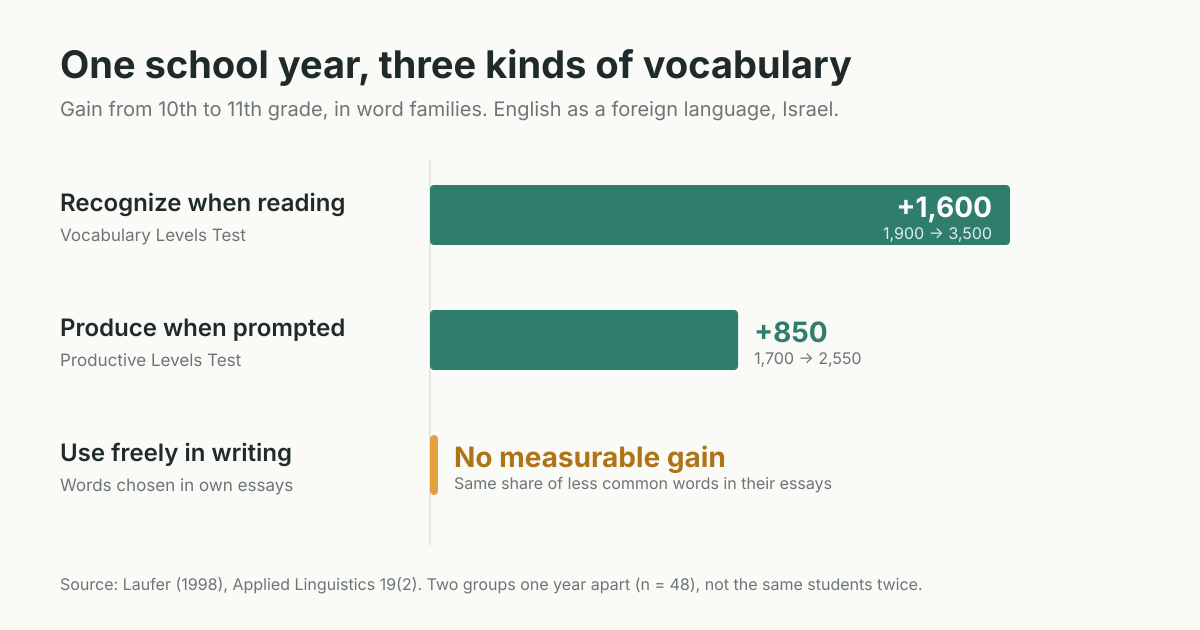
Batia Laufer measured this gap properly. Her Israeli high school students took three kinds of test: recognizing words, producing them when given the first letters, and using less common words unprompted in their essays. The chart above compares 10th and 11th graders. Recognition was up by about 1,600 word families, prompted production by about 850, and free use not at all.
Those were essays, where you can stop and think. Speech is less forgiving.
She compared two groups a year apart rather than following the same students, and they were in normal classes, not a reading program, so don't lean too hard on the exact numbers. The order keeps turning up in later research, though, with recognition first and production well behind.
Why Speed Is the Part Reading Can't Train
Skill researchers keep finding that practice is stubbornly specific. Get good at understanding a structure and you've mostly got good at understanding it. Producing it is a separate skill, and it improves when you produce. Language is less strict about this than a tennis backhand, as the VanPatten result shows, but it's strict enough.
What speaking adds is the clock. You have to find the word and get it into a sentence while the other person is waiting, and reading never asks that of you. You get faster at it by doing it, badly at first, a lot of times.
This is where this blog parts ways with the purer input crowd. "Keep reading and it will emerge" is reasonable advice if you have ten years and no conversations coming up. Most adults have a job interview in March. If you only read, expect to understand far more than you can say for a long time. If you only talk, you'll get quicker, mostly with words you already had.
How to Make Your Reading Show Up When You Speak
None of this needs a tutor. It needs a few minutes of speaking straight after you read, while the story is still fresh.
The most useful habit is also the most uncomfortable. Close the story and retell it out loud in about a minute, to an empty room. You'll get stuck almost immediately on a verb you understood fine on the page. That's the gap Swain was describing. Reread, and you'll notice the missing words on the way past.
Then pick three phrases you'd actually use, whole phrases rather than single words, and say them again before bed. A voice message to a friend counts. So does muttering them on the stairs. To shrug is a good one to start with.
If a specific conversation is coming up, read something set in it the night before: a story about a doctor's visit before the doctor's visit. Words you met recently come back faster.
Reading dialogue out loud helps too, mostly because dialogue is the part of a story people actually say.
Next time, the fork will probably still lag a beat behind. It lags less when you've said tenedor out loud this week instead of only seeing it. Generate your first bilingual story about the conversation you're dreading, and retell it once before you go in.
Related reading:
- Collocations: Why You Know Every Word and Still Sound Wrong
- Grammar Through Reading
- Comprehensible Input: The Science Behind Why Stories Beat Flashcards
Start reading bilingual stories for free
Start reading bilingual stories for freeNot sure of your reading level? Take the free CEFR test →