Fiction vs. News: What to Read When You're Learning a Language
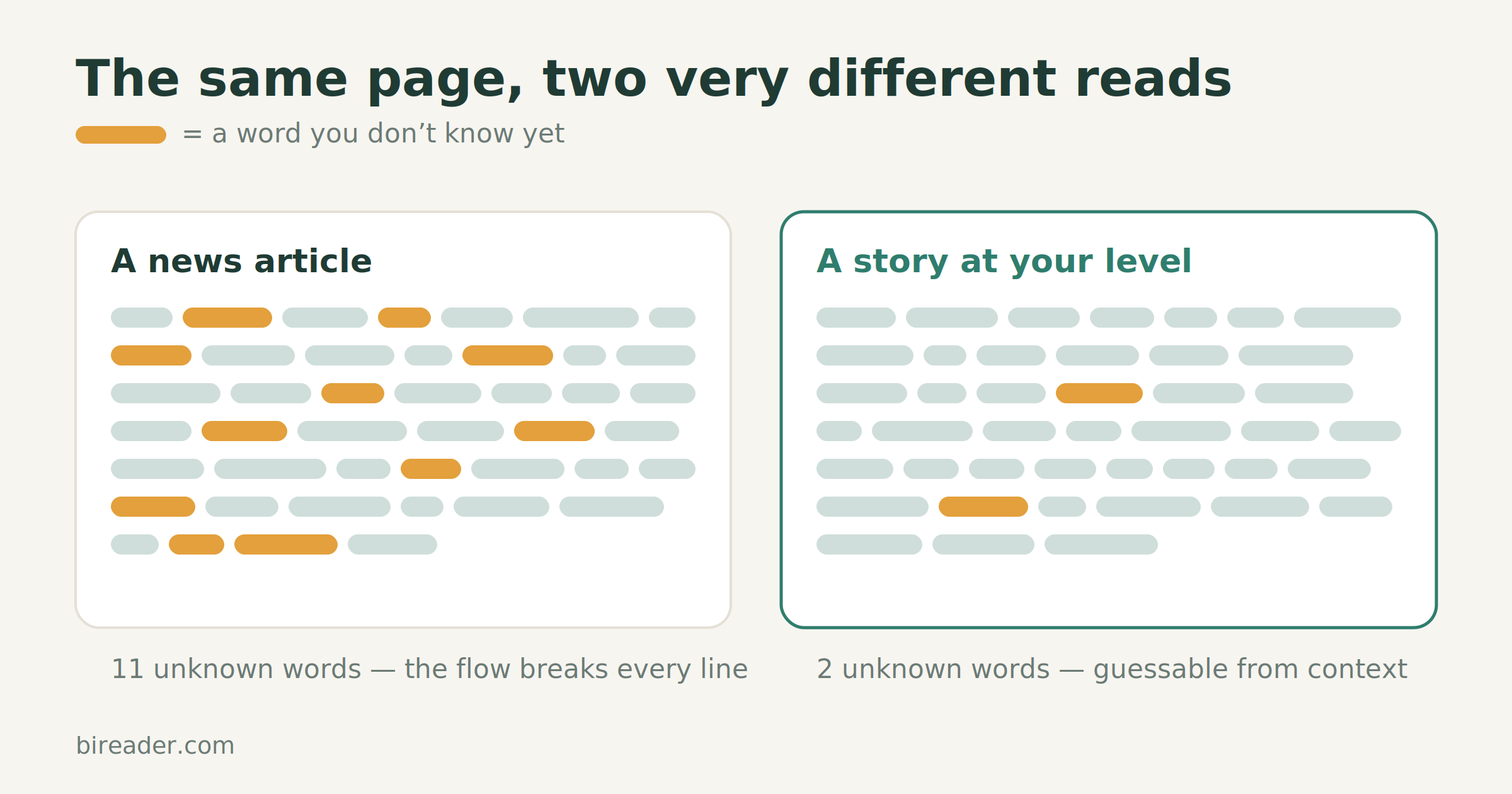
Reading the news in your target language feels like the adult choice. Real events, real prose, none of this invented-story business. Then you open an actual article, and the second sentence hands you three politicians' names, an acronym, and something about stalled coalition negotiations. You close the tab and conclude you're not ready.
You are ready. Just not for that. News prose is assembled from the rarest, least reusable material in the language — and it's assembled for native readers who bring twenty years of background knowledge to every headline. Fiction gets dismissed as the soft option. For a learner, it's the denser one: more usable words per page, more repetition, more of the language people actually speak.
Try the method first: generate your first bilingual story and compare it to the front page of any newspaper in your target language. The difference is measurable, and this post is about why.
Why News Feels Like the Serious Choice
The logic seems airtight. News is authentic. It's free, it's short, it's about the real world, and it refreshes every morning. Reading it makes you feel like a participant in the language rather than a student of it.
Then the logic meets an actual article. Ana has around 2,500 Spanish words and opens El País over breakfast. The first paragraph gives her two ministers she's never heard of, one government agency, the phrase "moción de censura," and a verb in a tense she recognizes but can't parse at speed. She understands the topic is politics. That's all she understands.
Ana's conclusion is that her Spanish is worse than she thought. The correct conclusion is different: nothing about her level changed between the graded story she finished on Tuesday and this article. What changed is the material.
News Front-Loads the Rarest Words in the Language
Corpus research puts the vocabulary needed for comfortable reading — around 98% word coverage — at roughly 8,000 to 9,000 word families, for novels and newspapers alike. The summit is the same. The climb is not.
A news article compresses low-frequency vocabulary into every sentence: institutions, legal terms, economic jargon, and a rotating cast of proper nouns that no dictionary will help you with. Monday's article is about parliament, Tuesday's about a hospital merger, Wednesday's about interest rates. Three days, three specialist vocabularies, almost no overlap. Each article spends its rare words once and never hands them back.
Anything below full coverage bites harder here than anywhere else. At 85% coverage a text is nearly unreadable — and news pushes you below that line faster than any other genre, because its unknown words carry the meaning. Miss "indictment" in an article about an indictment and the remaining 97 words are decoration.
The grammar compounds it. Headlines run on their own compressed dialect — dropped articles, present tense for past events, noun piled on noun. The first sentence you see on any news page is the least normal sentence in the paper. As a model of the language, it's actively misleading.
What a Story Recycles That an Article Can't
A story is a closed world, and closed worlds repeat themselves. The same characters keep appearing, in the same kitchen, doing the same daily things — waking, arguing, cooking, leaving. When "la estufa" shows up in the second paragraph of a story about a grandmother's kitchen in Oviedo, it comes back in paragraph six, and again near the end, each time with a little less friction. By the last page you're not translating it. You're just seeing a stove.
That's spaced repetition without the flashcards. The natural frequency of words inside a narrative does what a review app does artificially: it brings a word back right around the time you'd otherwise lose it. News can't do this. Every article opens a new world and closes it 400 words later.
Fiction is also the only written genre that teaches you how people talk. Dialogue in a novel is speech — interruptions, refusals, jokes, the short blunt sentences of an argument. Quotes in a news article are prepared statements from officials. One of these will help you when someone actually speaks to you.
A story compounds, too. Page ten is easier than page one, because page one already taught you its words, its people, and its habits of phrasing. You read faster as you go, and reading faster means meeting more words per minute, which is the entire engine of vocabulary growth. A newspaper never gets easier as you move down the page. It just changes topic.
And narrative does something to memory that reporting doesn't. A word met inside a scene gets stored with the scene — the rain, the kitchen, the argument about the stove. A word met inside a paragraph about fiscal policy gets stored with nothing, because there was nothing to attach it to.
The Real Difference: Fiction Comes in Levels. News Doesn't.
Here's the structural fact underneath all of this. News is written at exactly one difficulty: the journalist's, aimed at educated native adults. You cannot ask Reuters for a B1 edition of this morning's events.
Fiction is the only genre that exists at every level. A story can be written with 400 words or 40,000, and it's still a real story — with tension, characters, and an ending — either way. Graded readers have exploited this for decades. Generated stories take it further: the text is built around the words you know, plus a thin layer of ones you don't, which is the one ratio at which reading teaches instead of punishes.
So the choice was never really fiction versus news, as genres. It's a text that can meet you at your level versus a text that structurally can't.
When News Actually Works
None of this makes news useless. It makes news a tool for later — and for specific jobs.
The threshold is real but reachable: with 4,000 to 5,000 word families, roughly a strong B2, news stops being a wall and becomes merely hard. If you live in the country, work in the language, or are preparing for an exam that uses press texts, news earns its place before then, difficulty and all.
There's also one way to make news behave more like fiction: follow a single running story instead of skimming headlines. An election, a trial, a transfer saga. Coverage of the same event repeats its vocabulary day after day — the candidates, the charges, the fee — and repetition is the whole reason stories work.
Marek does this with a corruption trial in Gazeta Wyborcza. Day one costs him eleven lookups. By Thursday, "oskarżony," "zeznania," and "prokuratura" — defendant, testimony, prosecutor's office — read like old acquaintances, because the trial keeps producing them. He has, in effect, turned the news into a serialized story with recurring characters. That's the trick: it works because it borrows fiction's structure. A week inside one news story teaches more than a month of scattered front pages.
Keep the proportions honest, though. News as a supplement, something like a fifth of your reading. Stories as the base that builds the vocabulary news will eventually demand.
The order matters more than the debate. Six months of stories at your level buys you the news. The news, started too early, mostly buys you the belief that you can't read. Generate a bilingual story at your level, read it the way Ana couldn't read El País — at full speed, following the meaning — and you'll feel what input is supposed to feel like. The front page can wait. It'll still be there when you're ready, and sooner than you think.
Related reading:
- Choosing Your Reading Level: How to Tell If a Story Is Too Easy or Too Hard
- Vocabulary Size: How Many Words You Actually Need to Read
- Why Rereading the Same Story Beats Reading a New One Every Time
Start reading bilingual stories for free
Start reading bilingual stories for freeNot sure of your reading level? Take the free CEFR test →