Reading Speed: The Skill Nobody Tells You to Train
You read the whole sentence. Every word in it was a word you know. And by the time you got to the verb at the end, you had lost the subject at the start, so you went back to the beginning and read it again.
That is not a vocabulary problem. You just demonstrated the vocabulary.
It is a speed problem, and it is the one component of foreign-language reading that almost nobody is told to work on — because everyone assumes it takes care of itself.
Try the method first: Generate your first bilingual story
Nobody Reads a Second Language at Full Speed
Start with the baseline, because the number you have probably heard is wrong.
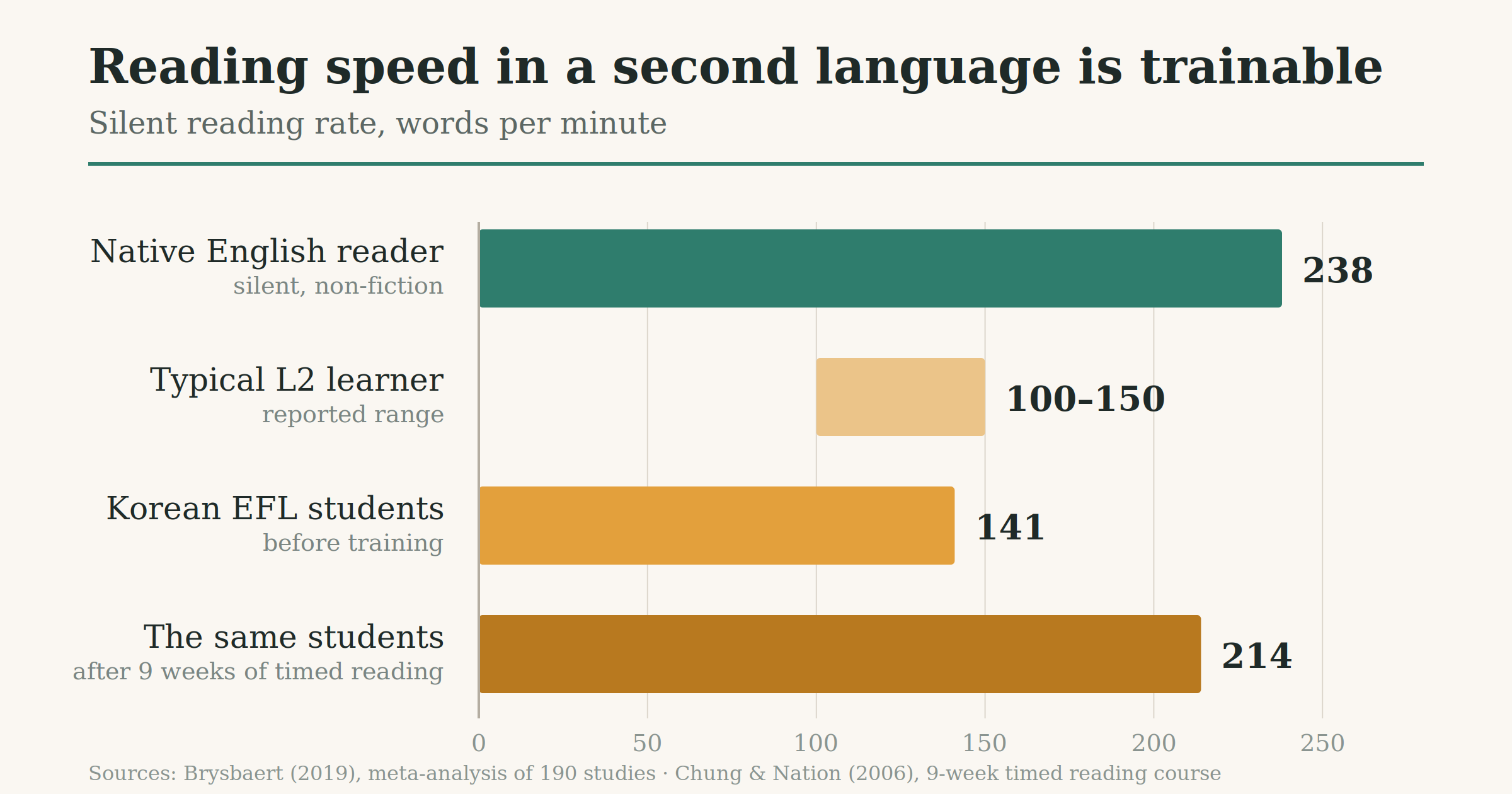
Marc Brysbaert pooled 190 studies covering more than 18,000 participants and put the average adult silent reading rate in English at 238 words per minute for non-fiction and 260 for fiction. Reading aloud drops it to 183. The 300 wpm figure that gets quoted everywhere came from small samples of college students and does not survive the meta-analysis.
Now the second language. Studies of EFL learners routinely report rates between 100 and 150 words per minute, and rates below 100 are not unusual. Even at the upper end of the published range, learners in higher education tend to land somewhere between 118 and 207.
Those samples lean heavily on Japanese and Korean university students reading English, which is close to a worst case — different script, distant language, limited exposure. So take the cleanest comparison available instead. Nathalie Cop and colleagues had proficient Dutch–English bilinguals read half a novel in each of their languages while an eye tracker watched. In their second language they were 17% slower, with longer fixations, shorter forward jumps, and fewer words skipped outright.
Seventeen percent, for people reading a European language closely related to their own, at a level most learners would sell a kidney for. That is the floor. The middle of the distribution is closer to half speed.
Which raises the question of why anyone should care. Slower reading just means the book takes longer.
What a Slow Sentence Does to Your Memory
It does not just mean the book takes longer. It means you understand less of it.
Charles Perfetti's verbal efficiency theory, set out in 1985 and still the standard account, starts from a hard constraint: working memory is finite, and reading has to run several processes inside it at once. Recognising the words. Assembling them into propositions. Holding the subject while you wait for the verb. Resolving the pronoun three clauses later. Connecting any of it to what you already know.
When word recognition is automatic, it costs almost nothing, and everything left over goes to the parts that actually produce meaning. When word recognition is slow and deliberate, it eats the budget. There is nothing left to think with.
The damage concentrates in long sentences, for a reason you can feel: by the time you reach the last words, the first ones have decayed. Nadia has 3,000 Spanish words and is halfway through a paragraph about a woman leaving a hospital in Valencia. The sentence runs twenty-eight words. She crosses it in twenty seconds, which sounds fine. But the subject was in word three, the verb that governs it is in word twenty-two, and by then the subject is gone. She reads it again. She understands it on the second pass and concludes the sentence was hard.
The sentence was not hard. It was long, and she was slow, and those two things multiply.
Speed Does Not Arrive on Its Own
The standard assumption is that rate is a side effect. Learn more words, and speed follows automatically. Partly true — but only partly, and the evidence for treating it as a separate skill is better than most learners realise.
Chung and Nation ran a speed reading course with 40 Korean university students: 23 timed readings over nine weeks. Average rate went from 141 words per minute to 214. A 52% gain in two months, from an intervention that added no vocabulary at all — the passages were deliberately built from words the students already knew. John Macalister later found the gains partly transfer, with learners carrying roughly 30 wpm across to text types they had never trained on.
Nothing about those students changed except that they practised moving.
Paul Nation's framework for a balanced language course allocates a quarter of the time to fluency development — making faster use of what you already have, as opposed to acquiring anything new. In practice it gets close to zero. William Grabe, reviewing 35 years of the field, notes that reading rate training is seldom addressed at all, and that most reading classes spend their time on accuracy and grammar instead.
Two honest qualifications, because this is where the literature gets less flattering. Speed training reliably produces speed; it does not reliably produce dramatic comprehension jumps inside a single short study. Fukkink, Hulstijn and Simis trained word recognition for two days, improved word recognition, and found no comprehension gain. The comprehension benefits show up in longer work and in aggregate — the US National Reading Panel's meta-analysis of repeated reading across 99 comparisons found a moderate effect, not a spectacular one. Fluency is incremental. It is also cumulative, which is the part that matters over a year rather than a fortnight.
The Condition That Makes Training Possible
Nation's target for a second-language reader is around 250 words per minute — the same ballpark as a native silent reading rate. But the target comes with a clause attached that does all the work: it applies to material containing no unknown vocabulary and no unknown grammar.
That clause is the whole problem.
You cannot build reading speed on text that stops you. Every unknown word is a full stop, and a page with six of them is not slow reading, it is six separate readings with gaps between them. The rate you measure on difficult text tells you nothing about your rate, because you are not reading — you are decoding with pauses.
Which explains why almost no learner ever trains this. Most people read exclusively at the edge of their ability, because difficulty feels like progress and easy text feels like cheating. It is the one condition under which speed cannot develop. Nadia reads a page of Bolaño at 40 words per minute, feels the effort, and books it as a hard session well spent. She has trained nothing except her tolerance for stopping.
The material that would let her train is material she considers beneath her.
How to Actually Train It
The protocol is unglamorous and takes about five minutes.
Pick a text where you know essentially every word — 98% coverage minimum, and 100% is better for this specific purpose. Note the word count. Start a timer. Read it once, straight through, and do not look anything up, do not reread a sentence, do not stop when a word feels wobbly. Stop the timer. Divide words by minutes.
Then check yourself. Nation's speed reading materials pair every timed passage with comprehension questions for a reason: without them you will optimise for the number and start skimming, which is a different skill and a useless one. If comprehension drops below roughly 70%, you were not reading faster, you were reading less.
Write the number down. Do it three or four times a week on fresh passages at the same level. Expect the curve to be lumpy and the trend to be up.
Two things worth knowing. Rereading a passage you have already read, specifically for speed, is the other well-supported route — repeated reading studies with EFL learners have improved both rate and comprehension. And you cannot train silent speed by reading aloud, because your mouth caps you at around 183 words per minute no matter how fluent you become.
The bottleneck is finding text easy enough to run on. Graded readers exist but run out fast, and native material at your exact frequency band does not exist in any organised form. A bilingual story solves it from the other direction: the text sits at a density you can move through, and when a word does stop you, the translation is already in the parallel column — a glance, not a departure, and the sentence you were holding in working memory survives it. Generate your first bilingual story at your level and time yourself on it.
Reading slowly is the most invisible problem in language learning, because it never announces itself as a problem. It disguises itself as a hard text, a difficult author, a bad day. You will not notice it going away either — there is no session where the language suddenly opens. What happens instead is that one evening you finish a chapter, look up, and realise you never once went back to the top of a sentence.
Related reading:
- Extensive vs. Intensive Reading: Why Volume Beats Analysis
- Choosing Your Reading Level: How to Tell If a Story Is Too Easy or Too Hard
- Reading Aloud vs Reading Silently: When Each One Actually Helps
Start reading bilingual stories for free
Start reading bilingual stories for freeNot sure of your reading level? Take the free CEFR test →