Extensive vs. Intensive Reading: Why Volume Beats Analysis
Forty minutes on one paragraph of Spanish. Nine dictionary lookups, two subjunctives untangled, and by the end you understood every syllable.
You also read sixty words.
Keep that up for an hour a day and you'll have covered the amount of input a 9,000-word vocabulary requires in roughly ninety years.
The forty minutes weren't wasted. You did learn something. But you spent almost all of your time doing the thing that doesn't scale, and there is a second way to read a foreign language that almost nobody is taught.
Try the method first: Generate your first bilingual story
The Two Kinds of Reading Nobody Told You About
Harold Palmer split reading into two operations a century ago, and language teaching has been quietly ignoring one half ever since.
Intensive reading is what school taught you. A short passage, deliberately above your level. Dictionary open. Grammar unpacked. Comprehension questions at the end. The goal is to extract the maximum from a minimum of text.
Extensive reading is the inverse operation. Long, easy, self-chosen material, read fast, with no dictionary and no test waiting at the end. Richard Day and Julian Bamford, who wrote the standard account of it, set out principles that read like heresy to anyone raised on textbook exercises: the material should be easy, you should choose it yourself, you should read as much as possible, and you should read faster rather than slower. The reading is its own reward. Nothing gets checked.
Easy means genuinely easy — one or two unknown words per page, not one or two per sentence. Most learners have never read anything in their target language at that density, because nobody ever gave them anything that simple that wasn't also insulting.
Which raises the obvious objection. If nothing is being studied, drilled, or tested, what exactly is supposed to be getting learned?
The Arithmetic That Decides It
Words don't stick on first contact. Stuart Webb and Paul Nation's review of the research puts the requirement at somewhere between seven and sixteen encounters, spaced out rather than crammed, before a word is reliably yours.
In 2014 Nation ran the numbers on what that means in practice. He built corpora of different sizes and asked a simple question: how much text do you have to pass through your head to meet the words at each frequency level twelve times?
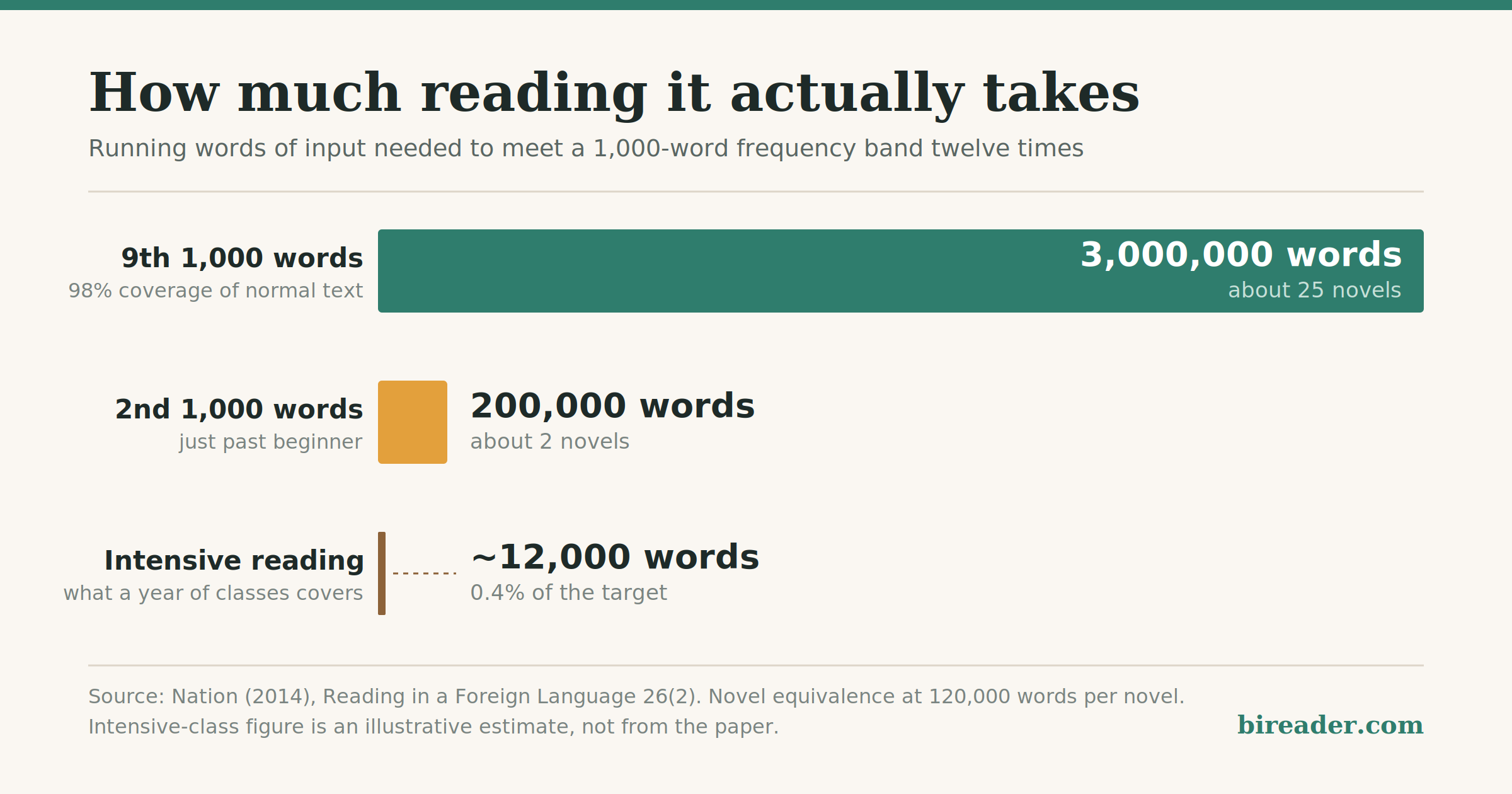
For the second thousand most frequent words — the ones just past absolute beginner — a little under 200,000 running words does it. For the ninth thousand, the band you need for 98% coverage of ordinary text, you need about three million.
Three million sounds impossible until you convert it into objects. Nation does: at roughly 120,000 words per novel, three million is twenty-five paperbacks. Modelled at 150 words per minute, that's around eight hours and twenty minutes a week across a forty-week year. A faster reader at 200 words a minute needs about six hours ten.
Now price the same target in intensive reading. A weekly class working through a few hundred words of dense text covers maybe twelve thousand words in an academic year. Against three million, that is four-tenths of one percent.
None of which proves that reading a lot works. It only proves that reading closely can't produce the volume. Whether volume actually does anything is a separate question — and the honest answer starts badly.
One Book Barely Moves the Needle
Rob Waring and Misako Takaki tested this in the least flattering way available. Fifteen Japanese learners read A Little Princess, a graded reader written to a 400-headword level. Twenty-five target words were tracked, with their spellings altered so that no participant could possibly have known them beforehand. The words were sorted into bands: some appeared fifteen to eighteen times in the book, some appeared exactly once.
On an immediate multiple-choice recognition test, learners got about 40% of the target words. Three months later, roughly half of everything they had gained was gone. Meanings decayed faster than word forms. Most of the target words were never learned at all.
If you were hoping one graded reader would hand you a hundred new words, it won't. Reading is a genuinely poor method for learning any particular word.
But look at which words survived. Frequency was the divider — the words that appeared fifteen to eighteen times stuck and resisted decay. The ones that appeared once evaporated, exactly as you'd expect.
That result is usually quoted as a strike against extensive reading. It isn't. It's the operating principle. A word you meet once and forget has cost you nothing — you didn't stop, you didn't break the story, you lost four seconds. You'll meet it again in the next book, and the one after that, and somewhere around the twelfth encounter it stops being a stranger. The failure rate per encounter is high and completely irrelevant, provided the encounters keep coming.
What Happened When Someone Ran the Experiment
Fiji, 1980. Warwick Elley and Francis Mangubhai took eight rural primary schools and did something the ministry probably regretted approving.
Around 380 children in Grades 4 and 5 were given access to 250 high-interest English storybooks and left to read them. A control group of 234 stayed on the Tate Oral English Program — the standard audiolingual curriculum, structures learned orally first, then consolidated through vocabulary-controlled readers. Careful, sequenced, thoroughly intensive.
After one year, the reading groups had pulled clearly ahead on reading and listening comprehension. After two years, the gap had widened into grammar and writing. The finding that made the study famous, published in Reading Research Quarterly in 1983 and replicated in Singapore, Sri Lanka, South Africa and the Solomon Islands: a book flood roughly doubles the rate of acquisition.
Nobody taught those children grammar. They read stories, and their grammar scores went up anyway.
Adults produce the same pattern. Thomas Robb and Bernard Susser ran extensive reading against a conventional skills-building course with Japanese university freshmen over an academic year; the extensive readers, who averaged 641 pages, did at least as well, and found it considerably more interesting. David Beglar and colleagues later tracked which Japanese undergraduates gained the most reading speed across a year. The answer: the ones who read around 208,000 words, mostly simplified texts at or below the 1,600-headword level.
Read that last part again. The students who picked harder books improved less.
Where Intensive Reading Still Earns Its Place
None of this makes close reading worthless. Nation's own framework for a balanced course gives it a quarter of the time — one of four strands, alongside meaning-focused input, speaking and writing, and deliberate fluency practice. A quarter. Not the whole plate.
There are jobs only intensive reading can do. You've been guessing at the Spanish subjunctive for eight months; ten minutes with one paragraph and a grammar reference will do more than another novel. A rental contract, a medical leaflet, an exam text where a misread clause costs you something real — those need the dictionary and the second pass.
Susser and Robb's rough calibration was that extensive reading means reading about ten times as much as an intensive programme covers. That ratio is where most learners actually fail. The mistake isn't doing intensive reading. It's doing only intensive reading, four hundred words at a time, and believing that counts as reading.
The Problem With Reading Easy Things
Here's what nobody mentions when they recommend extensive reading: the material barely exists.
Tomás has about 1,200 Spanish words. The graded readers pitched at that level are written for fifteen-year-olds and mostly concern football tournaments and haunted campsites. The book he actually wants — Bolaño, or a decent thriller — sits at maybe 80% coverage for him, which isn't reading. It's decoding with long pauses.
So he does what everyone does. He opens the hard book, looks up nine words in the first paragraph, and forty minutes later he's sixty words in, back where this article started.
The lookup is what kills it. Every trip to the dictionary is a forty-second break in the sentence you were holding in your head, and extensive reading depends entirely on that thread staying intact. Reading faster rather than slower isn't a stylistic preference in Day and Bamford's principles — it's load-bearing.
Bilingual stories remove the trip. The text sits at the density you can actually move through, and when a word does stop you, the translation is already there in the parallel column. No tab. No app switch. No forty seconds. You glance and keep going, which is the only way anyone has ever accumulated three million words. Generate your first bilingual story at your level and see how the method feels.
Extensive reading will feel, for a long time, like it can't possibly be working. Nothing is drilled. Nothing is tested. Half the words you meet slide straight past unlearned, and you'll know it. That's the arrangement — you're not trying to win any individual encounter, you're trying to reach encounter number twelve, nine thousand times over, and pages are the only route there. The first book teaches you almost nothing. The twentieth is the one where you notice you've stopped counting.
Related reading:
- Vocabulary Size: How Many Words You Actually Need to Read
- Choosing Your Reading Level: How to Tell If a Story Is Too Easy or Too Hard
- Why Rereading the Same Story Beats Reading a New One Every Time
Start reading bilingual stories for free
Start reading bilingual stories for freeNot sure of your reading level? Take the free CEFR test →