Sleep and Vocabulary: What Happens to New Words Overnight
Marta reads a Spanish story on her phone at 10:30 at night. Someone told her new words stick better if you sleep on them.
For flashcards, that advice holds up well. For the words she meets in the story, the one study that checked found sleep made no difference at all.
That doesn't mean sleep is useless to readers. It means the night does less of the work than Marta was told, and the next day does more.
Try the method first: Generate your first bilingual story
What Sleep Does to a New Word
In a well-known experiment at the University of York, people learned invented words like cathedruke. Each one sounded almost like a real word, in this case cathedral.
Learning them was quick. After a few minutes, people could recognize cathedruke without trouble. But knowing a word and owning it are different things, and the researchers had a clever way to test the difference.
When you hear "cathedr…", your brain starts guessing the ending before the word is over. Every word you own that starts that way joins the guessing. If cathedruke has really become one of your words, it joins too, and you get a tiny bit slower at hearing cathedral. The delay is only a few thousandths of a second, but it shows the new word is now part of your vocabulary.
People who learned the words at 8 in the evening showed no delay that night. The next morning, they did.
People who learned at 8 in the morning showed no delay that evening, after 12 hours awake. The delay appeared only the morning after, once they had slept.
So the hours didn't matter. The night did.
Think of a new word as a sticky note. It's quick to write and easy to lose. While you sleep, your brain copies many of the day's notes into your real vocabulary, where they last. That copying is what the morning test picked up.
Why Evening Study Kept More Flashcard Words
The York test measures something you can't feel. A 2006 study in Germany measured something you can: how many words you still remember a day later.
American high school students learned lists of 24 English–German word pairs, either at 8 in the morning or at 8 in the evening. They were tested again one day or a day and a half later.
The evening group forgot clearly less. How long they waited before the test barely mattered. What mattered was how soon they slept after learning.
Then the researchers asked some students to stay up all night after learning, watching TV and playing games. Everyone got at least one full night of sleep before the final test, two days later. The students who missed that first night still remembered less. They weren't tired by test day, so tiredness can't explain it. The missed night itself cost them words.
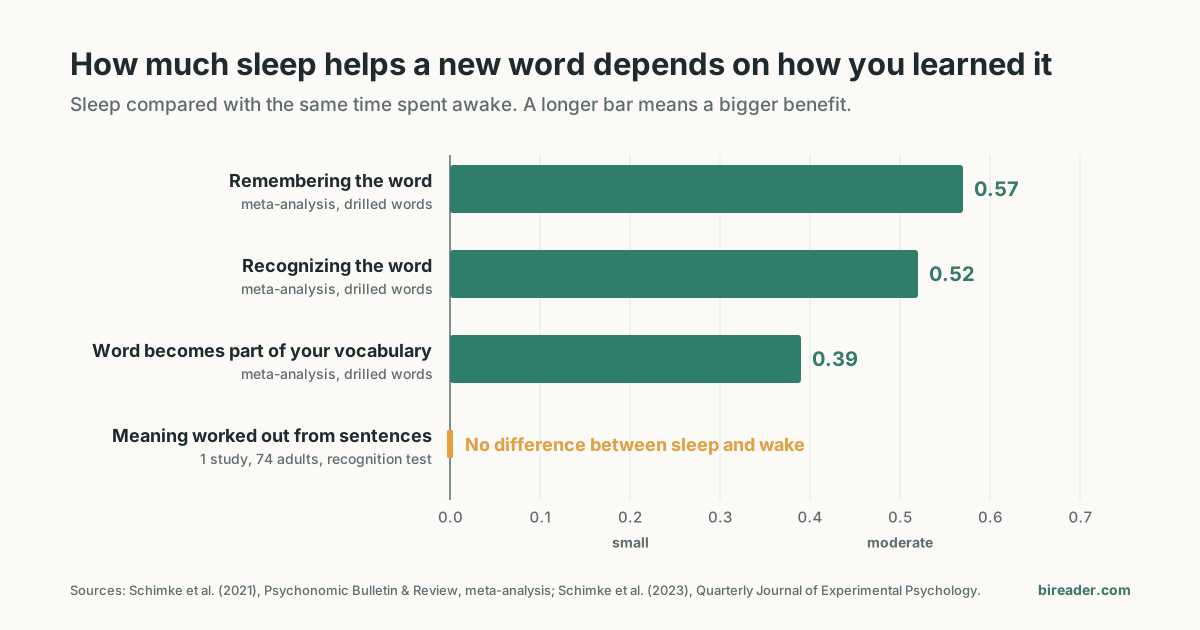
Those groups were small, 12 students in one test and 14 in the other. But later research backs them up. In 2021, a team in Australia combined 25 studies with almost 1,400 adults. Sleep beat staying awake on every kind of test: remembering a word, recognizing it, and the York-style test of whether it had become part of your vocabulary. The first two effects were moderate. The third was smaller.
Now look at how the people in those studies learned their words.
The Study That Tested Reading
Almost all of them learned words in one of two ways. Some heard bare sounds, like cathedruke. The rest saw pairs, the way a flashcard app shows them: a word and its translation, a word and a picture, a word and a definition. Almost nobody learned words the way you meet them in a book.
So in 2023 the Australian team tested that. Seventy-four young adults read 20 invented words, each inside a pair of sentences, and had to work out what it meant:
The earth is shaped like a karok.
The children held hands and formed a karok.
Half did this in the evening and then slept. Half did it in the morning and then spent the day awake. Twelve hours later, both groups were tested.
The two groups scored the same. Sleep made no difference.
The researchers think working out a word from sentences uses different parts of the brain from memorizing a pair, and depends less on the night. Results from other labs point the same way. In one, new words became part of people's vocabulary within a single day, with no sleep at all, when practice was spread out and mixed with the real words they sounded like. In another, it happened after 20 minutes of training.
Don't stretch this too far. It's one study. It only tested whether people recognized the meaning. And the words were invented English words, not words in a foreign language.
There's also evidence pulling the other way. In a 2015 study, children and adults heard new words in a spoken story, and by the next day those words had clearly settled in. But nobody in that study stayed awake instead, so we can't tell whether the night did the work or just the passing time.
So sleep clearly helps words you drill. For words you pick up while reading, the evidence is thin, and so far it suggests the night matters less. Nobody has tested this yet with people reading a real foreign language.
Should You Read Before Bed?
Back to Marta. Tonight's story has madrugada in it, the hours after midnight before dawn. A baker in the story starts work at four, in the madrugada.
Marta doesn't need to change anything. Reading in the evening isn't a mistake. It just doesn't earn her an extra boost.
If you also review saved words or flashcards, do that part in the evening. That's where sleep helps most, and a short review doesn't need a fresh mind.
Read at whatever time you'll actually do it. Nothing in the research says to move your reading to the evening, and nothing says to stop if the evening is your only free time.
The one thing to avoid is staying up later to study more. Remember the students who skipped a night: two days later, after catching up on sleep, they still remembered fewer words.
And skip the apps that play vocabulary while you sleep. In lab studies, replaying words during sleep helped people keep words they had learned earlier that evening. Nothing in this research shows it teaching new ones.
How to Use the Next Morning
Sleep does one more useful thing: the next morning, it shows you which words stayed.
Open yesterday's story and look at the words you marked. Some will come back right away. Those notes made it into your vocabulary overnight. Others will look familiar, but the meaning won't come. Those are still sticky notes.
Don't drill them. Meet them again in a sentence. Reread yesterday's story, or generate a new story at your level that uses the words you missed. That is how readers learn words: the same word, again and again, in different sentences.
Marta meets madrugada with the baker on Monday. On Wednesday she meets it again, in a taxi taking someone home from a long night out. Now the word comes with two scenes, not just a translation.
Each night copies a few more notes, and words from stories don't depend on any one night. Miss a good night's sleep and those words are probably still there. Skip the next meeting with them and they probably aren't.
So read tonight whenever it suits you, and go to bed on time. Tomorrow, before anything new, open yesterday's story and count the words that came back on their own. Then reread the sentences with the ones that didn't.
Related reading:
- The Forgetting Curve: Why New Words Vanish in 24 Hours — and How Reading Interrupts It
- Why Rereading the Same Story Beats Reading a New One Every Time
- Daily Reading Habit: Why 15 Minutes a Day Beats Two Hours on Sunday
Start reading bilingual stories for free
Start reading bilingual stories for freeNot sure of your reading level? Take the free CEFR test →