Why Children's Books Won't Teach You a Language
The advice sounds unimpeachable: start with children's books. They're written for people who don't know many words — and right now, that's you. So you buy a Spanish fairy-tale collection, open to page one, and meet erizo, madriguera, and refunfuñó. Hedgehog. Burrow. Grumbled.
Three words in, and not one of them will ever come up in a conversation you actually have.
This isn't bad luck with one book. It's the predictable result of a category error — reaching for texts written for small fluent people when what you needed was texts written for large non-fluent ones. The two have almost nothing in common.
Try the method first: Generate your first bilingual story — written for learners, at your level, about something you'd actually read.
Children's Books Are Written for Fluent Speakers
A native five-year-old is not a beginner. By the time a child sits down with their first picture book, they carry thousands of words and essentially all the core grammar of their language — acquired by ear, for free, over five years of total immersion. The book's job is not to teach them the language. They already have it. The book's job is to entertain them and, later, to teach them to read.
Which means authors of children's books never restrict their vocabulary the way you'd hope. They do the opposite. A bedtime story competes for a child's attention with everything else in the room, so the language stretches: animals scamper and scurry instead of running, villains are sly and wicked instead of bad, soup becomes porridge and pots become cauldrons.
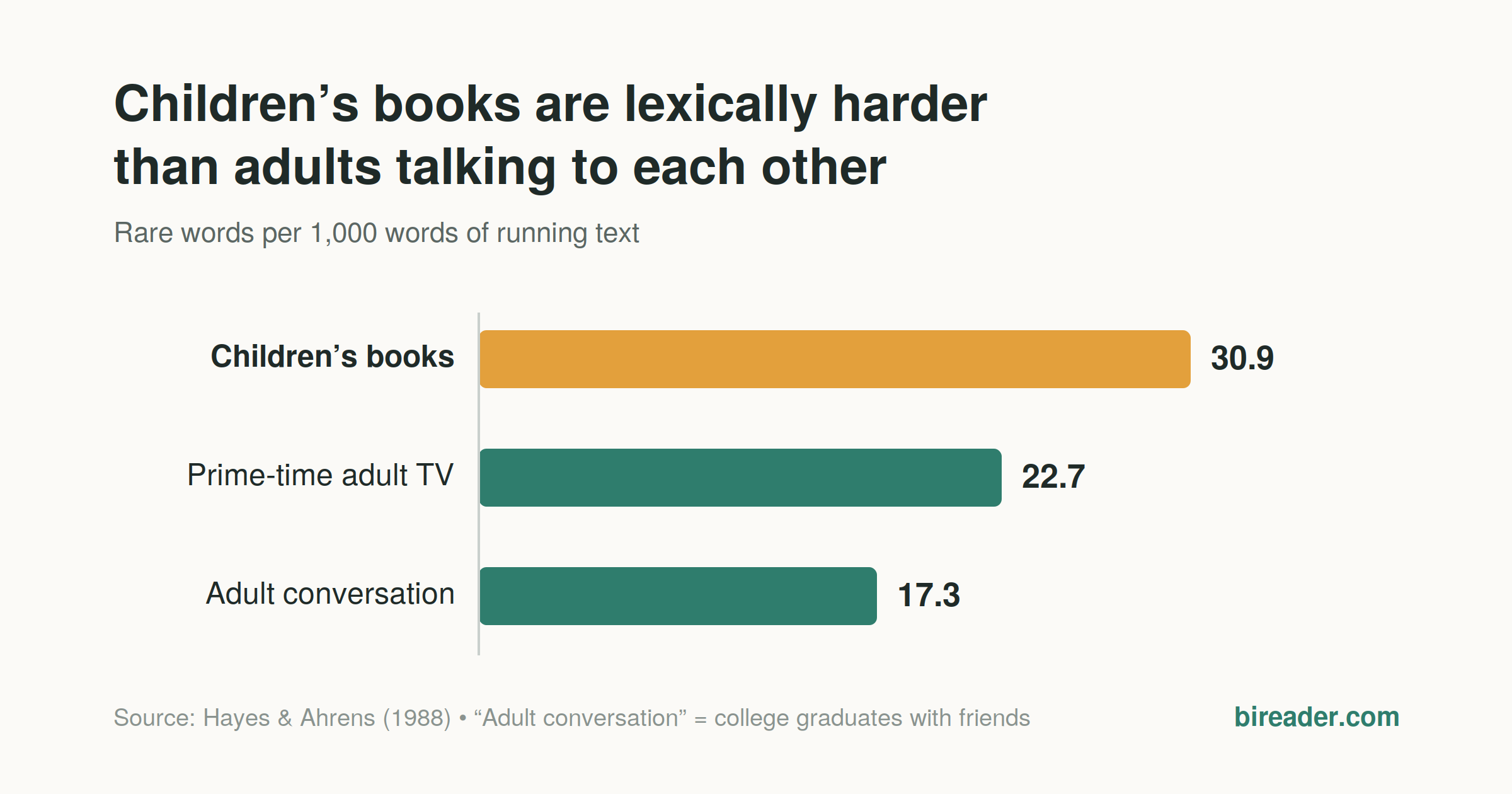
There's data on this. A well-known study by Hayes and Ahrens measured how many rare words different kinds of language contain per thousand running words. Children's books came out around 31 — higher than prime-time adult television at about 23, and far higher than the everyday conversation of college-educated adults at about 17.
Read that again. The children's book on your shelf is lexically harder than adults talking to each other. "Start with kids' books because the words are simple" has the facts exactly backwards.
The Vocabulary Is Rare, Not Simple
Marta is learning English. Someone tells her to start with the classics, so she opens Goldilocks. In the first two pages she looks up porridge, stool, and wee — as in the Wee Bear, whose wee chair gets broken.
Every one of those lookups costs her the same effort as learning although, decide, or probably. But those three words will appear in nearly every text she ever reads, while porridge will wait years for its next appearance — probably in another fairy tale.
This is the frequency problem, and it's brutal at the beginner stage. Your first thousand words determine what percentage of normal text you can follow. If that thousand includes spindle, gobble, tiptoe, and the names of eleven forest animals, you've spent your budget on words that cover almost nothing. You'll finish the book, feel like you worked hard, and still be unable to read an email.
The trap is disguised, because these words look easy. They're short, they're cute, the picture on the page tells you what they mean. So the reading session feels productive — no dictionary needed, plenty understood. But "understood in the moment with a picture" and "acquired for use" are different things, and neither one changes the fact that the word itself was a poor investment. You decoded it cheaply. It's still nearly worthless.
Word counts aren't the goal. Coverage is. And children's literature is one of the worst coverage-per-effort deals in print.
The Grammar Is Older Than You Expect
Vocabulary is only half the trap. Children's stories sit inside a literary register that preserves grammar adults are explicitly told to postpone.
Open Le Petit Prince — the book every French learner is handed — and you're reading the passé simple on page one: me répondit-il, fit le petit prince. That's a literary past tense French courses defer until advanced levels because nobody speaks it. German fairy tales run on the written Präteritum while spoken German uses the Perfekt. Russian children's stories are dense with stacked diminutives that transform words past recognition. English tales invert freely — said he, off they went, down came the rain.
None of this is wrong. It's beautiful, and one day you'll enjoy it. But as a beginner you can't tell which patterns are the living language and which are fairy-tale costume. You end up studying forms your textbook says don't exist yet, wondering why the book and the course describe two different languages.
They do. And the book's version is the one you need later.
Boredom Is a Structural Problem, Not a Character Flaw
Suppose you push through anyway. The vocabulary is odd, the grammar is antique, but you're disciplined. Here's what actually kills the plan: reading works through volume, and volume requires wanting to know what happens next.
The method behind reading-based learning — comprehensible input — only compounds when you consume a lot of it, week after week. That's sustainable when the content pulls you forward. It collapses when every session means another twenty minutes with a talking badger who has misplaced his hat.
You're an adult. You have opinions about work, food, travel, relationships, money. A story built on any of those will drag you to the next paragraph on curiosity alone. A story built for a four-year-old asks you to supply, from discipline, the motivation the text refuses to generate — every single day, indefinitely.
There's one honest exception. If you genuinely love fairy tales — if you'd reread them in your own language for pleasure — then the motivation problem disappears for you, and the vocabulary problem shrinks, because cauldron and spindle are words you'll actually meet again in the texts you plan to keep reading. That's a real case. It's also rare, and it isn't the situation the advice assumes.
Everyone else quits after two weeks and blames their willpower. The willpower was fine. The content was load-bearing, and it wasn't carrying anything.
What "Start Simple" Should Actually Mean
The instinct behind the advice is right: you do need easier text. The mistake is where you look for it.
Simple, for a learner, means three specific things. High-frequency vocabulary — the words that cover the most text per word learned. Grammar from the living, spoken layer of the language, introduced in roughly the order courses teach it. And subject matter an adult wants to read, because the whole system runs on you coming back tomorrow.
Children's books fail all three. Graded, learner-directed stories are built for exactly those three. A story generated at A2 about a job interview in Barcelona gives you reunión, decidir, and aunque — words with a working life — inside grammar you've actually met, wrapped in a situation you recognize. Generate your first bilingual story at your level and compare it, sentence by sentence, with the fairy tale on your shelf.
The fairy tales aren't going anywhere. Around B2, when you can feel the difference between everyday language and storybook language, they become a pleasure instead of a maze. Until then, read like the adult you are — just at the level you're at. That combination isn't found in the children's section. It has to be built for you.
Related reading:
- Choosing Your Reading Level: How to Tell If a Story Is Too Easy or Too Hard
- Fiction vs. News: What to Read When You're Learning a Language
- Comprehensible Input: The Science Behind Why Stories Beat Flashcards
Start reading bilingual stories for free
Start reading bilingual stories for freeNot sure of your reading level? Take the free CEFR test →