Irina is on a video call with her Spanish tutor. She wants to say "tomorrow." What comes out is domani.
That is Italian. She started Italian three months ago and Spanish two years ago, and now the new language is getting into the old one. Every forum she checks says the same thing: never learn two close languages at the same time.
The advice is right about what happened on that call. It is mostly wrong about what happens when she reads.
Try the method first: Generate your first bilingual story
Why Does the Wrong Word Come Out?
When you try to say a word, your memory does not hand you one answer. It hands you every word you know for that thing. Mañana, domani, mâine, tomorrow. Usually the right one wins. The one you used most recently starts with an advantage.
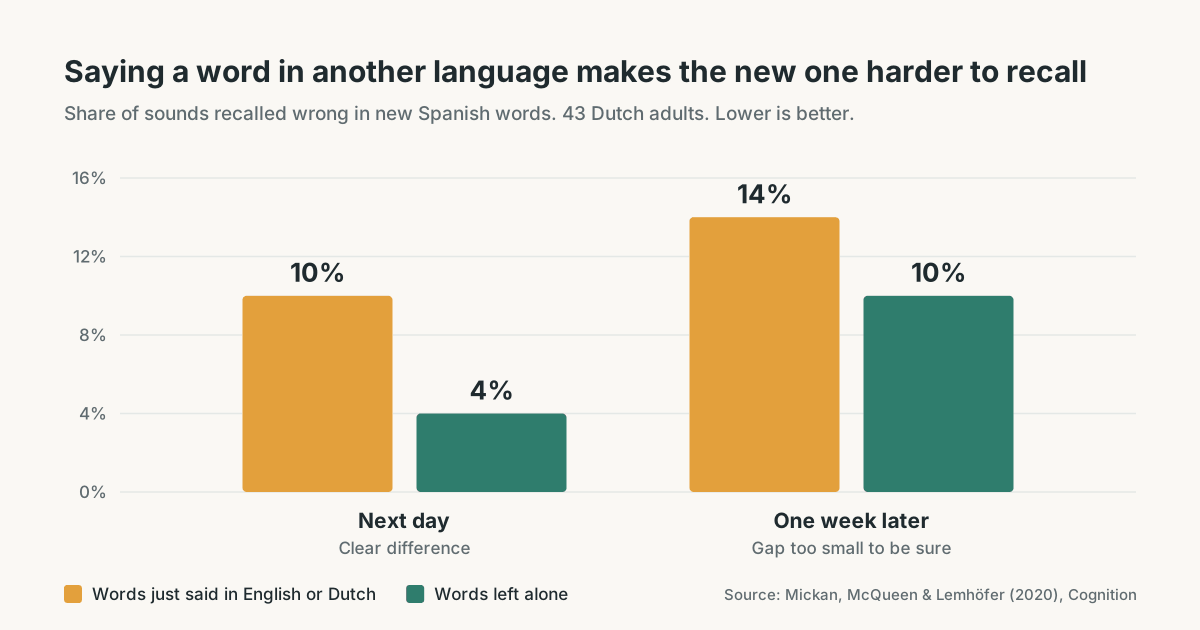
A research team in Nijmegen tested this directly. Dutch adults learned 40 new Spanish words on the first day. On the second day, they named pictures of half of those things in English or in Dutch. Then everyone was tested on the Spanish words again.
The words they had just said in another language came back worse. About 10% of the sounds in those words were wrong, against 4% for the words they had left alone. They were slower, too, and the slowdown was bigger when the other language was English, their other foreign language, than when it was Dutch.
A week later, the gap had shrunk to 14% against 10%. At that point it was too small to be sure it was real.
The same team later ran it the other way round. They taught Spanish words for things people already knew in English. Afterwards, people recalled those English words less accurately. They also failed to speed up on them, the way they did on English words with no new Spanish twin.
That is Irina's domani, measured in a lab. But look at what every one of these tests asked people to do: pull a word out of memory and say it. Nobody was asked to recognise a word on a page.
What Changes When You Read Instead?
Reading is a different task. The word is already in front of you. Your job is to know what it means, not to find it.
Competition does not disappear. In one study, 20 people who already spoke Spanish and English learned a made-up language whose letters sounded different from both. Words that looked like English or Spanish words were harder at first. Words that looked like words in both were the slowest to recover. Every learner still reached the training goal, and on a later listening task they picked the right picture 99% of the time. The interference was real, and it shrank with practice.
Finland has run a much larger version of this without meaning to. About one in twenty Finns grows up speaking Swedish, a language close to English. The rest grow up with Finnish, which is not related to English at all. For decades, English tests in Finnish schools have shown the same pattern: the Swedish speakers do better, and the gap is bigger still in listening.
The Swedish speakers also make more mistakes that come from their own language. They borrow a Swedish word that looks like an English one and means something else. So they make more transfer errors and get better results. A similar language costs you some wrong words and pays you back in everything you can understand without being taught. When you read, the payback is the part you notice.
One limit: the Finnish data are about a native language helping with a foreign one. Two foreign languages learned side by side are a weaker version of the same thing, because neither is as solid as the language you grew up with.
Does a Second Language Slow Down the First?
The research on people who already speak two languages points the other way. A 2018 review of studies on adults and children found that people who know more languages usually learn a new one better, especially its vocabulary. In one study, people who spoke English and Spanish, or English and Mandarin, remembered more made-up words than people who spoke only English. The new words looked like nothing they knew.
That does not prove studying two languages in parallel helps. Those studies compare bilinguals with monolinguals, not people who studied two languages at once with people who studied one. We found no long-term controlled study of adults starting two new languages at the same time. So there is no good evidence that parallel study damages either language, and no good evidence that it speeds either one up.
The clearest cost is arithmetic. Thirty minutes a day is about 180 hours a year. Split between two languages, that is about 90 hours each. Each language moves at roughly half the speed it would have.
The other cost is neglect. When 97 German students came home after about five months studying in Spain, they lost on average 4% of their Spanish picture-naming score over the next six months. Some lost much more, and a few improved. One of the clearest predictors was how much Spanish they kept using. How much English they used did not clearly matter. The risk was not the other language pushing in. It was the first one going quiet.
How Should You Split Your Time Between Two Languages?
Start the second language when the first can carry an easy story without a dictionary on every line. A language you already read comfortably resists interference better than one you are still building. This is an inference from the lab results, not something a study has tested over months, but it matches how the interference faded with practice.
Read in both languages every day, even if it is ten minutes in the stronger one. Use is what kept the German students' Spanish alive.
Keep the translation line in your strongest language. In one study, Hebrew speakers who also knew English learned German words better from Hebrew translations than from English ones. That held even though English is much closer to German. For Irina, that means reading Italian stories next to Romanian, not next to her half-built Spanish.
Before you speak, warm up in the language you are about to use. The word you used most recently wins. Ten minutes of a Spanish story before the call gives Spanish that head start instead of Italian.
And when two close languages share a word that looks the same, check it in both. You will catch the false friends faster on the page than on a call.
When Is One Language at a Time the Better Choice?
If you have an exam in one of them, give it all your hours until the exam. Half speed is a real cost when there is a date.
If your total study time is under twenty minutes a day, two languages will each get so little that neither builds momentum. One language that moves is better than two that barely do.
Two close languages both starting from zero, like Spanish and Portuguese, are the hardest case. In the made-up-language study, words that looked like words in two other languages were the slowest to settle. Learning both from zero means every new word has a near-twin competing with it. People do it, but expect more domani moments in the first months, and expect them to fade as one language gets stronger.
Irina did not need to drop Italian. She needed Spanish to be used every day, a Romanian line under her Italian, and ten minutes of Spanish reading before each call. The mix-ups happen when she speaks. When she reads, the two languages mostly help each other. Generate your first bilingual story at your level in either language and see how the two sit side by side.
Related reading: