FSI Language Hours: What the 600-Hour Estimate Leaves Out
You have probably seen the map. Spanish in green, 600 hours. Japanese in red, 2,200. It gets shared as a kind of promise: put in the hours, collect the language.
The number is real. It was measured on someone who is almost certainly not you.
Try the method first: Generate your first bilingual story
What the FSI Number Actually Measures
The figures come from the Foreign Service Institute, the school that trains American diplomats. FSI sorts languages into four groups by how long its trainees take to reach one fixed target. Those trainees are native English speakers, so every category measures distance from English. Start from another language and the same language can land in a different category.
Category I covers Spanish, French, Italian, Portuguese, Romanian and a few others: 24 to 30 weeks, or 600 to 750 class hours. German sits in Category II at about 36 weeks. Russian, Ukrainian, Polish, Greek, Turkish and dozens more make up Category III, at 44 weeks and 1,100 hours. Arabic, Mandarin, Cantonese, Japanese and Korean form Category IV: 88 weeks, 2,200 hours.
The target is the part nobody quotes. FSI aims for level 3 on the US government's proficiency scale, in speaking and in reading at the same time. A level-3 reader handles authentic prose on unfamiliar subjects, such as wire-service news, reports and arguments, at a normal speed and with almost complete comprehension.
That is not getting by on holiday. It is reading a ministry report in the language, then discussing it with the people who wrote it.
FSI itself calls the timelines averages, and says the real time depends on ability, earlier language experience and hours in class. Which raises an obvious question. An average of whom?
Who the 600 Hours Belong To
Two FSI staff members, Frederick Jackson and Marsha Kaplan, described the people behind the averages in a paper published in 2001. Their mean age was 41. Before starting, they already knew 2.3 languages other than English, on average.
The hour estimates in that paper carry a condition in the small print: they assume very good or better aptitude for classroom language study. People with less aptitude usually take longer, the authors add.
Then come the conditions of the course. Beginner classes in Spanish or French have six people at most. In harder languages, four or fewer. Trainees sit at least four class hours a day, five days a week, and then do three or more hours of independent study every day.
Even under those conditions, about two-thirds reach or pass their target. Most of the rest come close. FSI has tried to shorten its courses, and the paper says plainly that it did not work.
So picture the person in the 600-hour column. A professional in their forties who already speaks two foreign languages and tested well for aptitude. They spend the morning in a room of four with a trained teacher, the afternoon on homework, and they are paid to do nothing else for seven months.
The Hours Nobody Counts
Look again at the 750 class hours for Spanish. Thirty weeks at 25 class hours a week gives exactly 750. The homework is not in it.
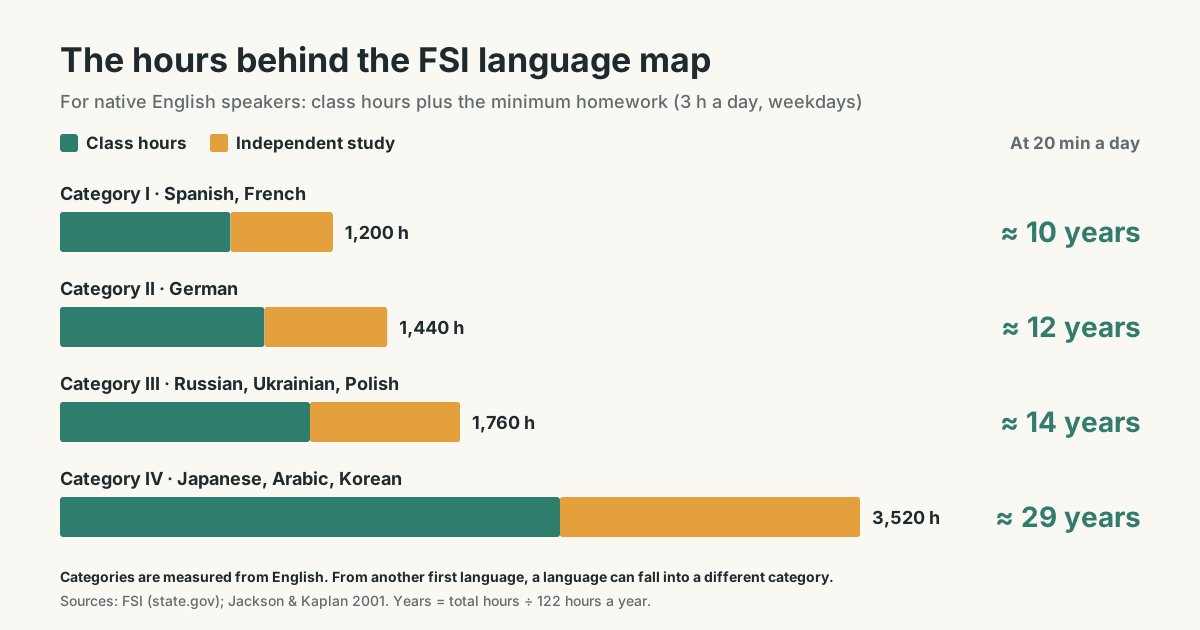
At the minimum FSI describes, three hours a day on weekdays, those 30 weeks add another 450 hours. The real total is at least 1,200 hours. A later FSI draft says much the same about Spanish and Dutch: around 600 hours in class, and almost as many again in guided study outside it.
Now take Rachel, a pharmacist in Leeds who reads Spanish for twenty minutes on the bus to work. Twenty minutes a day comes to about 122 hours a year. At that rate, 1,200 hours takes almost ten years. Japanese, with the same ratio of homework, comes to roughly 3,500 hours. That is about 29 years of bus rides.
Twenty minutes a day will not turn Rachel into a Spanish-speaking diplomat by next summer. Nothing about the method changes that arithmetic.
But the comparison is shakier than it looks, and the error runs both ways. An FSI class hour is one teacher working on four people's speaking, which means a lot of waiting for your turn. Twenty minutes of reading is twenty minutes of nothing but the language on a page. Nobody has measured how one converts into the other. Anyone who tells you an hour in an app equals an hour at FSI, or is worth three of them, is guessing.
And there is a bigger problem with the table than the exchange rate.
Why the Table Only Points One Way
Every number on the FSI list is measured from English. Russian is a Category III language for an American. For someone who already speaks Ukrainian, it is something else entirely, as Benjamin Rifkin, a professor of Russian, pointed out when explaining the categories.
Large datasets show the same thing. Researchers analysed the Dutch state exam results of about 50,000 adult immigrants. The closer a person's first language was to Dutch, the better they came to speak it. Older FSI data, reworked by the economists Barry Chiswick and Paul Miller, show the ladder from the English side. After the same 24 weeks of training, average speaking scores ran from 1.0 for Japanese to 3.0 for Swedish and Norwegian, with French at 2.5.
No official table like FSI's exists for other first languages, so nobody can tell you exactly where a language would land for you. The direction, though, is clear: the closer your own language is to the one you are learning, the easier the category it behaves like.
So if you are Oksana in Lviv, learning Polish, the 1,100 hours printed next to Polish were not measured on anyone like you. For her, Polish behaves much more like an easy category than a hard one. Ukrainian already gives you a large share of the vocabulary and the same system of cases. If you are Mihai in Brașov, learning Italian, Romanian has already done part of the work.
And if you are learning English, which most of the world is, English does not appear in the table at all. The list was built by English speakers, for English speakers.
If you started somewhere else, the map tells you very little about your route. What it does show, for everyone, is how much of the target sits in reading.
What to Do With a Number This Large
Remember what FSI is buying with all those hours: professional speaking and professional reading together. The two do not grow at the same speed.
In 1967, the psychologist John Carroll tested 2,782 university seniors majoring in foreign languages. In each of the four languages with enough data, French, German, Russian and Spanish, the median reading score was higher than the median speaking score. French majors reached about level 3 in reading and level 2 in speaking.
Reading runs ahead because you can do it alone, at your own pace, with nobody waiting for your answer. It also keeps going when classes stop. A four-year college Russian programme in the US offers about 425 classroom hours in total, by Rifkin's survey. In his study of more than 350 people from college Russian courses entering a summer immersion programme, only those with more than 600 hours of prior instruction reached advanced levels.
FSI's own staff draw a similar line. They write that time spent reading, listening and talking is closely tied to how well people end up using a language at work. They also say adults need large amounts of easy reading to build stamina.
None of this shows that twenty minutes of stories a day will get you to professional reading faster than FSI's timeline. That study has not been done. What it changes is how you use the map.
Decide which half of the target you actually need. If it is reading, the level below FSI's goal is a real milestone of its own: slow but dependable reading of familiar, factual material. You reach it long before anyone's 1,200-hour total. Then count your hours honestly, reading included, and judge them against your own starting language rather than against a diplomat's.
Rachel will not finish in thirty weeks. She has no teacher, no class of four and no employer paying for her afternoons. What she has is a bus ride every working day, for as many years as she wants it, and every ride goes toward the half of the target she can train alone. Generate a bilingual story at your level and start counting your own hours.
Related reading:
- Age and Language Learning: Why Adults Learn Faster at First
- Daily Reading Habit: Why 15 Minutes a Day Beats Two Hours on Sunday
- How Reading Improves Speaking, and the Part It Can't Fix
Start reading bilingual stories for free
Start reading bilingual stories for freeNot sure of your reading level? Take the free CEFR test →