Narrow Reading: Why One Topic Teaches More Words Than Ten
Reading a bit of everything feels like the smart way to build vocabulary. A news story on Monday, a short story on Tuesday, an article about volcanoes on Wednesday. Each one hands you twenty new words.
Almost none of them will come back.
A word you meet once is a word you will lose. If your reading jumps from topic to topic, most of the words you meet once are words you will never meet again in time to keep them.
Try the method first: Generate your first bilingual story
Why Reading Widely Starves You of Repeats
Kasia is a nurse in Gdańsk learning Spanish. She reads one article a day, and she picks a new subject each time so she never gets bored. A flood in Valencia. A football transfer. A new law on rents. On Thursday she meets embalse, a reservoir. She looks it up, nods, and moves on.
She will not see embalse again for months. By then it is gone.
Research does not agree on exactly how many meetings a new word needs. Estimates run from about 6 to about 20. Everyone agrees it is more than one or two. Common words take care of themselves, because they turn up everywhere. The words that are hard to get are the less common ones, and those depend on the topic.
This was counted directly in 1989. Two researchers took short newspaper stories and compared two kinds of sets. One kind was four unrelated stories. The other was a "running story", four reports on the same event over four days. In the unrelated sets, a less common word had almost no chance of showing up ten times. In the running stories, a much larger share of those words came back.
Kasia is not lazy. Her reading plan simply never gives a hard word a second chance.
What Changes When You Stay on One Topic
Narrow reading means reading many texts on one topic, or by one author, before you move on. The idea comes from Stephen Krashen, and it is simple. The same topic brings back the same words. Each new text is a little easier than the last.
The vocabulary side shows up in word counts. In one study, researchers compared nine news articles about the death of Princess Diana with nine articles on mixed subjects of the same total length. The Diana set used 156 fewer different words. Names came back far more often too. Over 41% of the names in the Diana set appeared eight times or more. In the mixed set, under 16% did. Fewer different words means fewer stops, and more of your attention left for the story.
The speed side shows up in a classroom. In Taiwan, 53 eighteen-year-olds spent about three weeks reading graded readers. One group read three Sherlock Holmes books. The other read three different versions of The Railway Children. At the end, each group read one text related to their books and one that was not.
On the related text, both groups read faster: about 142 and 146 words per minute, up from roughly 123 and 128 at the start. On the unrelated text, they were back near where they began, at 126 and 128. They also understood the related text better. On The Railway Children, the group that had read it three times scored 77% on comprehension. The other group scored 58%.
A third study looked at words directly. Sixty-one high-intermediate readers spent a month reading either texts on one theme or unrelated texts. The one-theme group knew the target words better and used them more correctly afterwards. Only the summary of that study was available to us, so we cannot give you its numbers.
All three point the same way. But they leave a question open. Is the benefit just "more repeats", or does it matter where those repeats happen?
Same Word, New Sentence: Why It Sticks Better
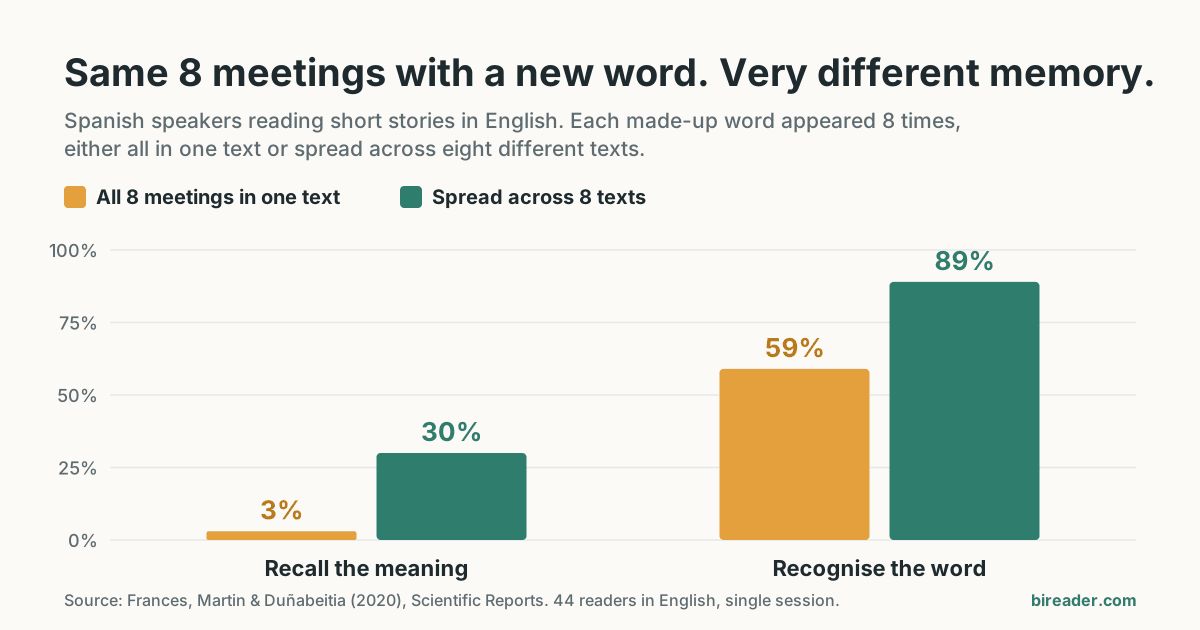
A study in Spain tested this cleanly. Eighty-eight Spanish speakers read short stories, half of them in English. Eight ordinary words in the stories were swapped for made-up words. Every reader met each made-up word exactly eight times. The only difference was where.
For some words, all eight meetings came in one text. For others, the eight meetings were spread across two, four or eight different texts.
The results, for the people reading in English: when a word stayed in one text, they could recall its meaning 3% of the time. When it was spread across eight texts, they recalled it 30% of the time. On an easier recognition test, the gap was 59% against 89%. Their understanding of the stories was the same in every case.
Same number of meetings. Ten times the recall.
Each new text shows the word in a new sentence, next to new words, doing a slightly different job. That gives your memory more ways back to it. This is what narrow reading delivers by design: the same words, in different texts.
It also adds a detail to our post on rereading. Rereading the same story still has a job. It builds speed and makes the text feel easy, and that matters. But for learning what new words mean, a new text on the same topic seems to do more than the same text again. Read a story twice if you like it. Then move sideways, not away.
One caution. The Spanish study used a single session, made-up words and readers who were already at a good level in English. It shows the direction clearly. It does not tell you how big the effect will be over a month of real reading.
Where Narrow Reading Fails
Not every kind of "narrow" works equally well.
A 2008 study counted words in fourteen collections of children's books. Some collections shared a theme, some shared an author, some were stories and some were factual books. In factual books, a shared theme brought back real content words. In stories, a shared author mostly brought back names of characters and places.
So a series of detective novels will give you "Holmes" and "Baker Street" fifty times. It will not reliably give you "suspicion" fifty times. If you want a topic's real vocabulary, the topic itself has to have one. Cooking does. Football does. A court case does. "Stories by one writer" mostly does not.
There are two other limits worth knowing.
The evidence is thin. There are a handful of studies, most of them short, with small groups, and most with English as the language being learned. No one has followed narrow readers for a year and compared them with wide readers.
And narrow is a phase, not a diet. If you read only about football for six months, you will know football Spanish very well and little else. The point is to stay long enough for a topic's words to settle, then move.
How to Read Narrow Without Getting Stuck
Kasia changed one thing. Instead of a new subject every day, she picked one she actually cares about, the flood in Valencia, and stayed with it.
Pick a topic with its own words. Food, medicine, a sport, a news story that runs for weeks. It should also be something you want to read about. Our post on topic interest explains why boring texts teach fewer words, and narrow reading only works if you keep going.
Stay for five or six texts at least. The studies used sets of four to nine texts. No one has found a perfect number, but one or two is too few for the repeats to start.
Mix stories and facts on the same theme. A story set in a hospital, then a short factual piece about hospitals. The factual piece brings back the topic words. The story keeps you reading.
Move to a neighbouring topic, not a new one. From floods to reservoirs to drought to farming. Some words carry over, so you never start from zero.
By her fifth text on the flood, Kasia had met embalse four more times. She did not look it up again. She noticed that she had stopped noticing it.
Reading widely gives you a long list of words you have seen once. Reading narrowly gives you a shorter list of words you actually own, and each one makes the next text a little easier. Choose a topic you care about, and generate a few bilingual stories on it at your level. By the third one, you will start to recognise the words before you reach the translation line.
Related reading:
- Why Rereading the Same Story Beats Reading a New One Every Time
- Topic Interest: Why Boring Texts Teach You Fewer Words
- The Pickup Rate: How Few New Words a Book Actually Teaches You
Start reading bilingual stories for free
Start reading bilingual stories for freeNot sure of your reading level? Take the free CEFR test →